
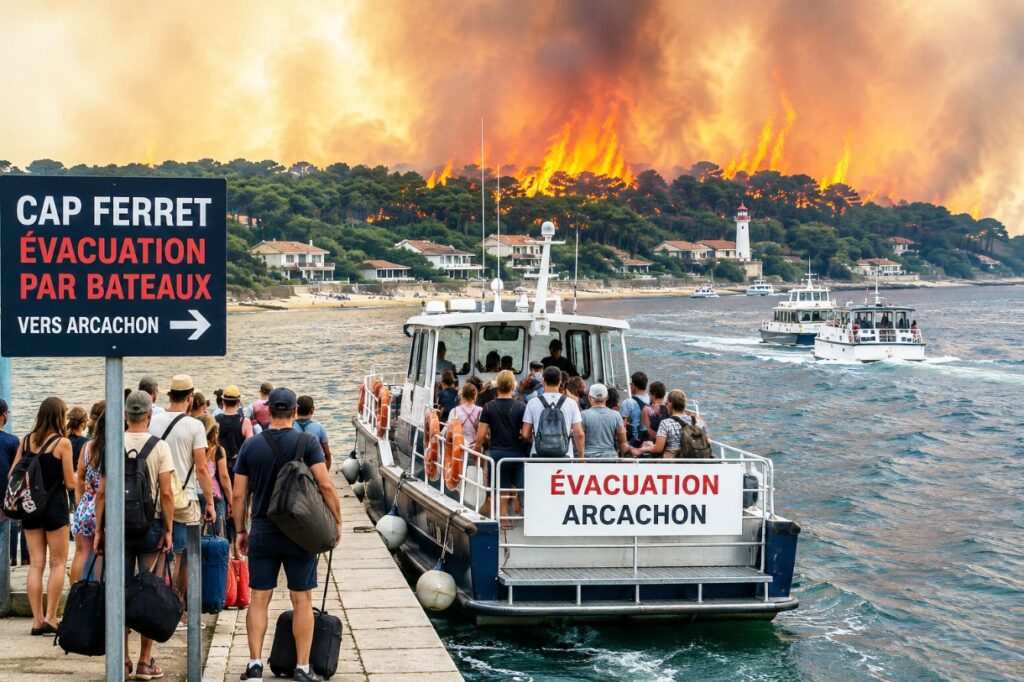
The situation on the Cap Ferret peninsula escalated dramatically overnight into Friday. The rapidly spreading wildfire forced authorities to take a measure that would be extraordinary even in a region accustomed to fires: the entire peninsula is to be evacuated in stages. In addition to the only road connection, the water route across the Bassin d’Arcachon is now being used extensively for the first time.
Between 7 and 10 a.m. on Friday morning, authorities set up a maritime shuttle service. From the piers at Grand Piquey, Le Canon, Port de la Vigne and Belisaire, vessels transported residents and holidaymakers to Arcachon on the opposite side of the bay. Several hundred people had already reached safety this way early in the morning.
The evacuation by water may appear spectacular at first glance, but it is taking place within the protected Bassin d’Arcachon. Nevertheless, it underscores the seriousness of the situation. Cap Ferret has only one road connection to the mainland, the RD106. In the height of summer, it regularly reaches capacity anyway. In the event of a major fire, the narrow access route could become a dangerous bottleneck, where any loss of time could have serious consequences.
The evacuation is therefore being carried out village by village. From Claouey in the north to the tip of the peninsula, residents were instructed in succession to leave their homes, holiday apartments and campsites. The communities most recently affected were Piraillan, Le Canon, La Vigne and L’Herbe. Those leaving the area either take the road towards Bordeaux or board one of the evacuation vessels at the designated piers.
To allow the boats to operate without obstruction, authorities banned all other shipping and water sports traffic in the Bassin d’Arcachon during the rescue operation. Motorboats, sailing yachts and jet skis had to remain in port so that the navigation channels were available exclusively to evacuation vessels. The aim was to avoid any delay.
The current situation also shows how forward-looking emergency planning can save lives. Following the devastating wildfires of 2022, the prefecture, municipalities and maritime authorities developed a detailed evacuation plan. The very four piers that were marked on maps at the time now form the backbone of the ongoing rescue operation. What was once regarded as a theoretical crisis scenario has become a bitter reality within just a few years.
The trigger for the full evacuation was the fire’s development during the night. According to authorities, the blaze broke through a defensive line established by firefighters at around 1 a.m. As a result, the flames moved dangerously close to the peninsula’s densely wooded residential areas.
By Friday morning, the fire had already consumed around 8,700 hectares of forest and vegetation. Several buildings fell victim to the flames, and a firefighter was injured in an explosion. The blaze was still considered out of control, while hundreds of emergency personnel fought tirelessly to contain its spread.
For the people on the ground, one thing matters above all in these hours: getting to safety in time. Many left their accommodation with only a few personal belongings, not knowing when they would be allowed to return. The small harbours, normally defined by excursion boats, oyster boats and holidaymakers, were transformed within hours into central hubs of a large-scale evacuation. The usually peaceful holiday paradise on the Bassin d’Arcachon vividly demonstrates how quickly nature can turn familiar landscapes into a crisis zone.
By C. Hatty