
The devastating wildfires in Gironde have long become more than a humanitarian and ecological disaster. While firefighters and emergency crews continue to battle the flames, the economic damage is growing day by day. Closed businesses, disrupted supply chains and absent tourists are putting enormous pressure on the regional economy. Small and medium-sized enterprises in particular, which often have only limited financial reserves, are affected.
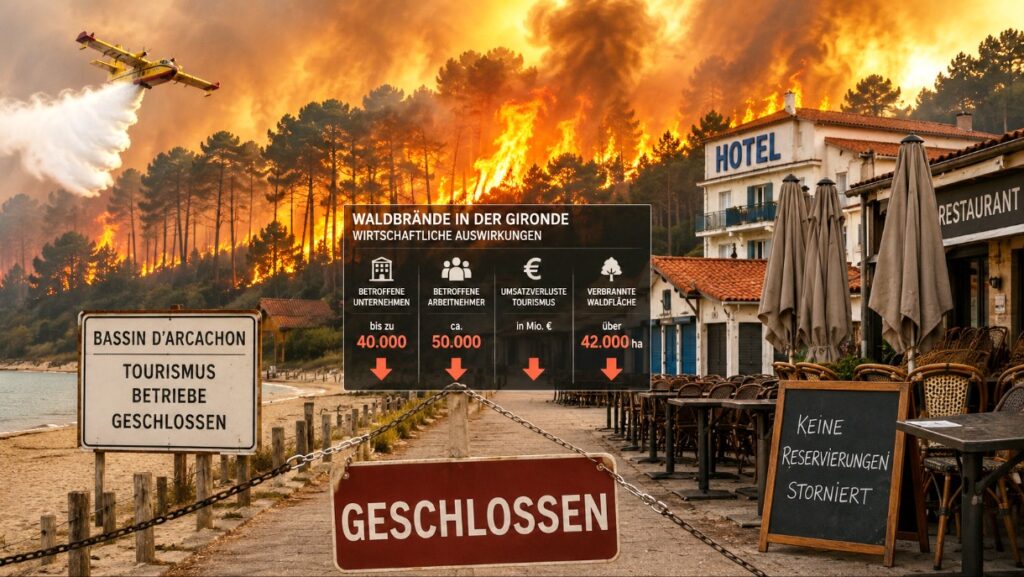
According to the French Ministry of Economy, more than 13,500 companies have already had to suspend operations, at least temporarily. The Bordeaux Gironde Chamber of Commerce and Industry now estimates that around 14,500 businesses have been directly affected. Including indirect impacts, as many as 40,000 companies could see their business operations restricted. An estimated 50,000 employees are affected by the consequences of the fires. The Chamber of Commerce has therefore set up a crisis unit together with other business organizations to support companies with insurance issues, compensation claims and the resumption of operations.
Evacuations Bring Entire Economic Regions to a Standstill
It is not only companies in the immediate vicinity of the fire zones that are suffering the consequences. Numerous businesses have had to close because their employees can no longer reach their workplaces due to evacuations, road closures or security zones. There are also power outages, disrupted supply chains and difficulties in obtaining raw materials and goods.
Economic losses increase with every additional day. The losses are mounting particularly quickly in the service sector. Restaurants are losing bookings and revenue during the peak season, perishable food has to be discarded, while rent, loans and payroll costs continue. Trades businesses are also often unable to carry out agreed contracts, creating additional financial burdens.
Small and medium-sized enterprises in particular are coming under considerable pressure as a result. They shape Gironde’s economic structure and often do not have sufficient reserves to absorb prolonged business interruptions. Just a few weeks without income can jeopardize their economic survival.
Tourism Loses Its Most Important Season
The disaster is hitting tourism particularly hard around the Bassin d’Arcachon, Lacanau and along the Atlantic coast. Hotels, campsites, holiday-home rentals, restaurants and leisure businesses are reporting numerous cancellations. The prefecture’s recommendation to refrain for the time being from traveling to particularly affected areas of Gironde has further heightened uncertainty.
Tourism has outstanding economic importance for the department. Around seven percent of regional economic output depends directly or indirectly on holidaymakers. Approximately 40,000 jobs are linked to the sector. The timing of the fires further aggravates the situation, as many businesses generate most of their annual revenue during the summer months of July and August. What is lost during this period can scarcely be made up later.
At the same time, regional officials are seeking to make distinctions. They point out that by no means all of Gironde is affected. Numerous wine-growing areas, coastal towns and tourist destinations continue to operate normally. A blanket perception of the department as a disaster area could therefore also harm businesses located far from the fire zones.
Agriculture Battles Smoke and Uncertainty
Agriculture also faces considerable challenges. Smoke and ash can affect vegetable fields, orchards and vineyards. Depending on the level of contamination, losses in quality or marketing restrictions may result. At the same time, road closures and evacuations are making harvesting and the transport of agricultural products more difficult.
Livestock farmers have in some cases had to move animals to safety or abandon grazing land. Irrigation systems and agricultural infrastructure can only be used to a limited extent in some areas. The long-term effects of the fires on yields and soil quality cannot yet be conclusively assessed.
Decades-Long Consequences for Forestry
The damage to forestry is even more severe. According to current estimates, more than 42,000 hectares of forest have been affected by the flames. The extensive pine forests of the Landes de Gascogne, among Europe’s largest contiguous commercially managed forests, have been particularly hard hit.
With the burned stands, forest owners and municipalities are losing not only valuable timber stocks but also long-term sources of income. It often takes several decades before newly planted pines can be commercially used. The consequences therefore extend far beyond the immediate disaster and will affect regional forestry for generations to come.
State Aid Intended to Prevent Insolvencies
The French government has announced initial support measures. Among other things, companies will be able to use short-time work arrangements to retain employees despite operational disruptions. In addition, assistance for affected businesses and simplified insurance and compensation procedures are being prepared.
The total economic damage is still impossible to estimate. What is already clear, however, is that the consequences of the wildfires extend far beyond the destroyed forest areas. Even once the last fires have been extinguished, many companies will continue to struggle with the economic consequences for a long time. For numerous businesses, the coming weeks will determine whether they survive the crisis or disappear from the market permanently.
By Andreas M. Brucker