
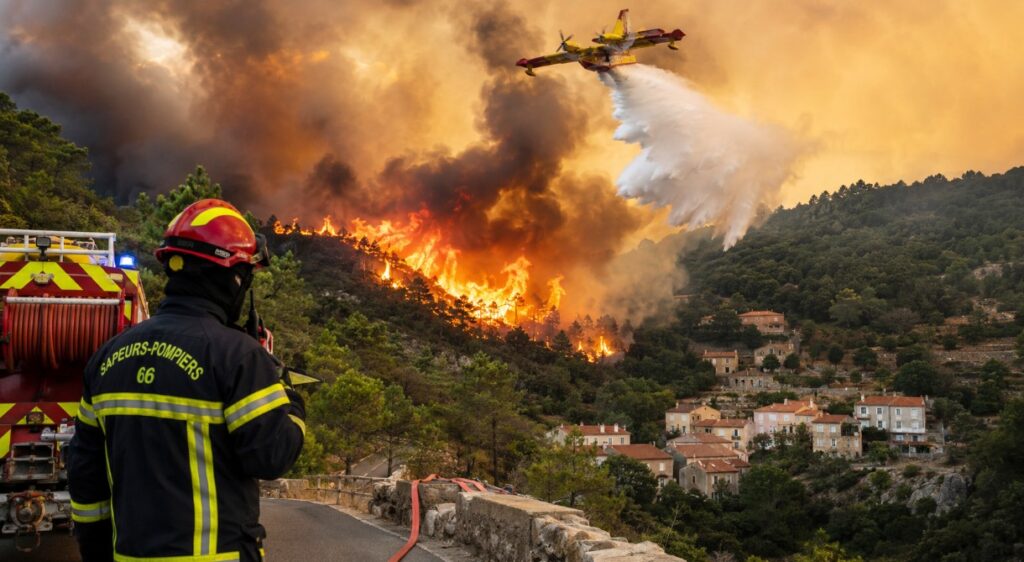
The smell of smoke hangs over many parts of southern France. Where pine forests only recently provided shade, black plumes of smoke now rise into the sky while firefighting aircraft drop their loads of water over the flames minute by minute. For the fire departments along the Mediterranean coast, this scene has long been part of everyday life — a reality that has reached a new dimension this summer.
In the departments of Pyrénées-Orientales, Aude, Var and other regions, one major operation follows another. Weeks of drought, temperatures beyond the 35-degree mark and the strong downslope winds Mistral and Tramontane turn the landscape into a highly explosive fuel bed. Often a single spark is enough. Minutes later the fire is already consuming hectare after hectare of dry vegetation.
For the fire service, a race against time begins. Fire engines quickly reach their limits in the rugged hills of southern France. Often the drivable road ends long before the fire front. The rest is covered on foot by the crews — wearing heavy protective gear, carrying hoses and tools on their shoulders. Every step costs energy; every ascent demands stamina.
However, the real danger does not lie solely in the flames. Dense smoke reduces visibility, heat shimmers over the ground, trees fall without warning. If the wind shifts, the entire operation can change within moments. From an apparently controllable situation, extreme danger can suddenly emerge. Then every decision, every radio message and every movement counts.
Many firefighters report that it is not physical exhaustion that weighs most heavily, but the feeling of powerlessness. Those who have to watch homes, vineyards or decades-old forests be lost despite all efforts take those images home with them. The responsibility for their own team accompanies every operation as well. The fire allows no mistakes.
France has one of the most effective wildfire-fighting systems in Europe. Thousands of female and male firefighters, specialized ground units, helicopters and the distinctive Canadair water-bombers form a tightly integrated response system. Nevertheless, it is increasingly apparent that even the most advanced technology reaches natural limits as soon as heat, drought and wind act together.
A trend has been developing for years that is now hard to ignore. The wildfire season starts earlier, ends later, and requires significantly more personnel than a few decades ago. Areas that were once considered comparatively safe now regularly come into focus for responders. Longer dry periods desiccate soils, vegetation loses its natural resilience, and fires spread with enormous speed.
The fire service’s mission long ago extended far beyond extinguishing fires. Evacuations of villages and campsites, protection of critical infrastructure and securing important transport routes are now also part of everyday operations. At the same time, many units support the population during extreme heat periods — a task that ties up additional resources.
Despite all the strains, the resolve of the crews remains remarkable. Comradeship, experience and the awareness of bearing responsibility for people and the landscape shape their work. At the same time, calls for consistent prevention are growing. Better-managed forests, stricter fire safety measures and a stronger awareness of careful handling of nature are seen as key building blocks to contain the effects of future fires.
The summer of 2026 marks another turning point. Wildfires are no longer regarded as extraordinary natural disasters but as a recurring challenge of a changing climate. For France’s fire services, this means a permanent adaptation of their professional role — and year after year a battle that reaches far beyond the immediate fire front.
By C. Hatty