
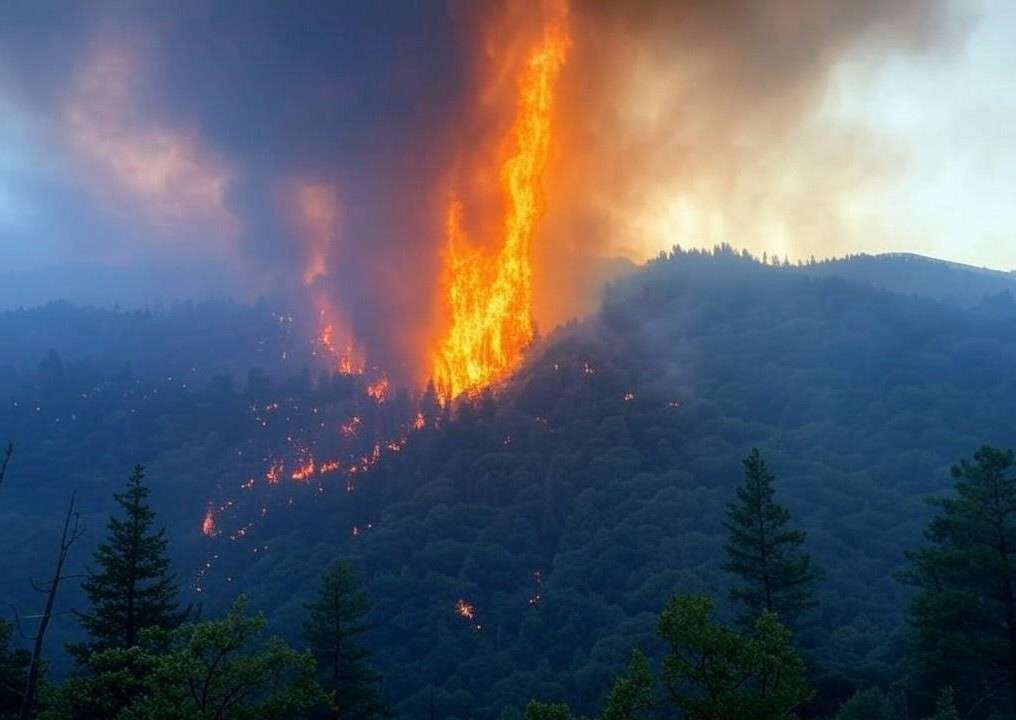
The wildfire situation in southern France is intensifying. Since Wednesday evening, hundreds of firefighters have been battling several large fires that are spreading rapidly due to drought, heat and strong winds. The departments of Aude, Hérault and Bouches du Rhône are particularly affected. For many residents, the summer of 2026 begins with an anxious question: How far will the flames reach this time?
The most serious fire started on Wednesday afternoon in the commune of Oupia in the Hérault department. Within a short time the fire spread to the neighboring department of Aude. By Thursday morning some 900 hectares were already ablaze. Adding up all simultaneously active fires, the area destroyed amounts according to various reports to more than 1,100 hectares.
Around 800 firefighters are battling the blaze there. They are supported from the air by Canadair water-bombers, Dash aircraft and firefighting helicopters. Dense smoke plumes and freshening winds repeatedly hamper operations. Authorities have partially evacuated endangered residential areas, and numerous roads remained closed for safety reasons.
The situation remains tense. Meteorologists expect gusts of up to 60 kilometers per hour. Such conditions can drive flames over large distances within minutes. A single spark is enough to create a new ignition point.
In the Bouches du Rhône department the night into Thursday also became an ordeal for emergency services. Two larger fires broke out north of Marseille.
In Rognac about 35 hectares of vegetation burned. Around 180 firefighters brought that fire under control and prevented it from spreading to inhabited areas. The situation was considerably more difficult between Lançon Provence and La Fare les Oliviers. There the flames had already consumed more than 200 hectares of scrub and woodland by midnight. As a precaution, authorities evacuated several residential areas on the edge of La Fare les Oliviers. Around 400 firefighters were on duty there around the clock.
However, the real accelerator of the fire does not lie solely in the fire itself. After the exceptional heatwave of the past days a powerful Mistral now meets a completely dried-out landscape. Grasses, bushes and forests resemble a tinderbox. Anyone who has walked through a Mediterranean garrigue in high summer can imagine how dry the vegetation has become. Often a tiny ignition source is enough. Frightening, isn’t it?
Météo France therefore raised several departments along the Mediterranean coast to the highest warning level for wildfire danger. Authorities are urgently appealing to residents and holidaymakers to observe all safety regulations. Open fires, barbecuing in endangered areas or carelessly discarded cigarettes currently pose an enormous risk.
The government is also responding to the tense situation. Acting Prime Minister Sébastien Lecornu is traveling to Marseille on Thursday to chair an interministerial crisis meeting there. The focus will be on the ongoing firefighting operations, the consequences of the recent heatwave and strategies for dealing with increasingly frequent extreme weather events.
It is already becoming clear that France faces a difficult wildfire season. The combination of rising temperatures, persistent drought and strong winds significantly increases the risk of large fires. Fire services have invested for years in modern equipment and improved operational concepts. Nevertheless, even experienced crews repeatedly reach their limits under such conditions.
For people in the affected regions, one thing matters above all right now: safety. Many are following developments with concern while emergency crews fight the flames around the clock. Hopes rest on a calming of the weather. Only when the Mistral subsides do the chances increase of containing the fires permanently. Until then southern France remains on the highest state of alert — and every hour without new ignition points gives firefighters a small bit of breathing room.
An article by M. Legrand