
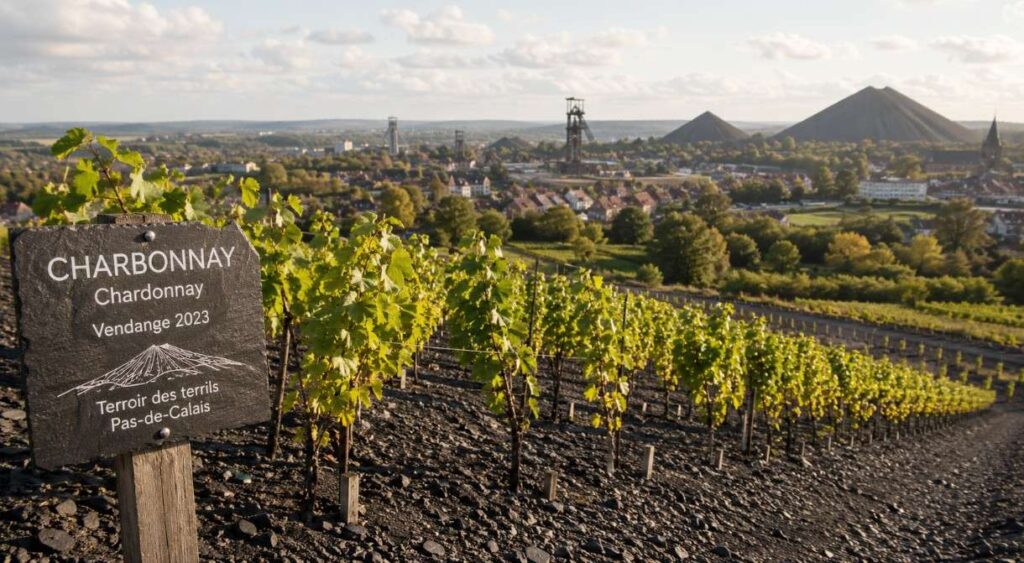
Traveling through the former mining region in Pas-de-Calais, one discovers a landscape in transition. Where mining towers once shaped the horizon and coal determined the lives of entire generations, the distinctive slag heaps are now changing their appearance. The black heaps, long perceived as visible scars of industrial history, now attract hikers, nature lovers, and photographers. And on some slopes, something has begun to grow that few would have expected here before: wine.
In Haillicourt near Béthune, rows of Chardonnay vines stand on the slopes of a former slag heap. The resulting cuvée bears a name with a wink: Charbonnay. The word combines “charbon,” the French word for coal, with Chardonnay. What at first sounded like an original marketing idea has developed into a remarkable symbol of the transformation of an entire region.
The first grape harvests took place as early as 2013. The harvest quantities remain modest to this day. Only a few hundred bottles leave the slope each year. This rarity is precisely what makes the wine sought after. But the real significance of the project lies not in its economic success, but in its message.
For decades, the slag heaps stood for hard underground labor, sweat, danger, and the industrial past of northern France. Today, they tell a new story. Many heaps have been transformed into viewpoints, natural areas, and recreational spots. Rare plants are settling, birds find refuge, and walkers enjoy views over the wide landscape. Nature has begun reclaiming places that were once created by human hands.
Viticulture adds another layer to this development. In fact, the experiment holds more substance than it might seem at first glance. The dark shale and rock fragments store heat especially well. The steep slopes benefit from favorable sunlight exposure. Added to this is a climate that has noticeably changed over the past decades. Regions that were previously considered unsuitable for viticulture are suddenly opening up new possibilities.
Twenty years ago, many experts would probably have shaken their heads. Wine from the former coal basin of northern France? Sounds crazy. Today, the idea seems much less far-fetched. New vineyards are appearing in various places in Hauts-de-France. These are still small projects, but they demonstrate how flexibly agriculture can adapt to changed conditions.
At the same time, Charbonnay reflects a remarkable cultural development. The industrial heritage of the mining region has had a new importance for years. Since the Bassin Minier was added to the UNESCO World Heritage list in 2012, attention no longer focuses exclusively on the decline of the coal industry. Instead, the relics of this era have come to the fore as cultural heritage.
The former mining towers, workers’ settlements, and slag heaps today stand not only for past times. They form the basis for new ideas. Museums, cultural events, hiking trails, and tourist offerings invigorate the region. The vineyards on the heaps fit perfectly into this picture. They connect past and future in a particularly vivid way.
Perhaps this is the greatest strength of the project. Nobody tries to erase or forget history. On the contrary. The memory remains visible. The slag heaps do not disappear under shopping centers or new housing developments. They keep their shape and their significance. But at the same time, they receive a new function. From a symbol of industry, they become a place of cultivation.
Of course, this development should not be romanticized. A few rows of vines do not solve structural problems. The mining era jobs do not return. Many communities still struggle with the consequences of industrial change. Economic challenges and social issues shape the everyday lives of many people to this day.
Nevertheless, the image of vines on black shale has a special power. It stands for adaptability, creativity, and the courage to take unconventional paths. Who would have thought that grapes would one day ripen precisely on the remnants of the coal industry? Sometimes the most exciting stories arise exactly where hardly anyone expects them.
The slag heaps of Pas-de-Calais impressively show that change does not always mean demolition. Sometimes it is enough to look at the ground anew. Something new grows from the relics of a past era. Slowly, unspectacularly, and yet full of symbolism.
An article by M. Legrand