
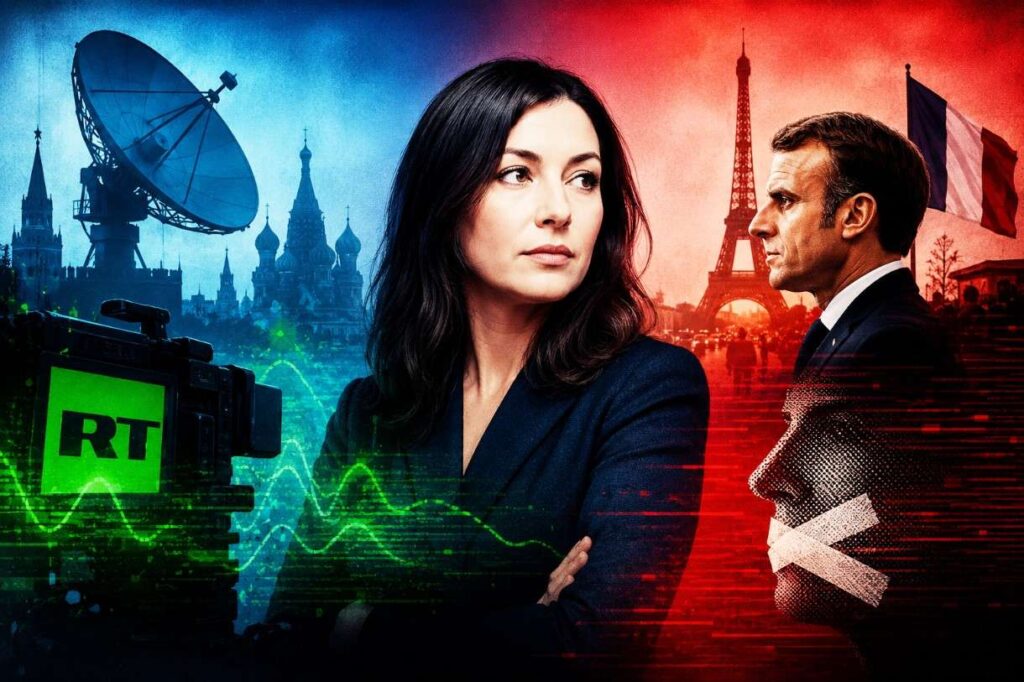
The controversy surrounding Xenia Fedorova has escalated to a new level after French President Emmanuel Macron personally intervened in the debate. At a press conference in Montenegro on June 4, Macron stated that the former head of RT France had already been serving Russian “state propaganda” in 2017 when he first publicly criticized her. Nothing has changed since then.
With this remark, Macron touched upon a conflict that dates back to the early weeks of his presidency. Already in May 2017, during a meeting with Vladimir Putin at the Palace of Versailles, he sharply criticized the Russian media outlets RT and Sputnik. He stated that both did not operate like traditional news organizations but functioned as tools of state influence by the Kremlin. These statements caused an international stir at the time and marked the beginning of a permanently tense relationship between the Élysée Palace and the Russian state media.
A Career Within Russian State Media
Xenia Fedorova comes from the Russian million-plus city of Kazan and built her professional career almost entirely within the RT media network. The broadcaster is funded from the Russian state budget and is one of the key instruments of Moscow’s international media strategy.
In 2017, Fedorova played a central role in establishing RT France. The French-language channel was intended to strengthen the presence of Russian perspectives in the French media market and reach an audience increasingly skeptical of established media. Fedorova took over leadership of the channel and remained at its helm until its closure in 2023.
The end of RT France was a direct consequence of European sanctions following the Russian attack on Ukraine in February 2022. The European Union justified the ban by assessing that RT was not an independent media company but an instrument of Russian war and disinformation policies.
Return to the French Media Scene
However, Fedorova did not disappear from public debate with the closure of RT France. On the contrary, in recent years she has gained a new platform in several media outlets of the Bolloré Group, including CNews, Europe 1, as well as various print and online publications of the group.
There, she regularly appears as a commentator on international topics, especially regarding geopolitics, the war in Ukraine, and relations between Russia and the West. It is precisely this media presence that has made her one of the most controversial voices within the French opinion spectrum.
Critics see her appearances as a continuation of the communication strategy that had already characterized RT France. They accuse her of spreading narratives that closely align with the Kremlin’s official positions. This particularly concerns the assessment of the Ukraine war, NATO‘s role, and the portrayal of Western sanctions against Russia.
Several media observers, disinformation researchers, and organizations supporting Ukraine have publicly analyzed and criticized her statements. In some cases, complaints were even filed with the French media regulator ARCOM.
The Accusation of Propaganda
The central question is not whether Fedorova represents Russian positions—she hardly denies this herself—but whether her public communication should be classified as a legitimate political standpoint or as propaganda.
The term propaganda has a particular political sharpness in democratic societies. It implies not just a political attitude but the systematic dissemination of information aimed at influencing public opinions in the interests of a state or ideological actor.
Macron and several members of the French government share precisely this assessment. Foreign Minister Jean-Noël Barrot recently explicitly called Fedorova a “propagandist” serving Russian interests.
For the French authorities, the case is exemplary of the challenge of dealing with foreign influence campaigns, which are increasingly spread through social networks, alternative media, and well-known commentators. Since the start of the Ukraine war, French security agencies have repeatedly warned about Russian information operations.
The Counterposition: Pluralism Instead of Censorship
Fedorova’s supporters firmly reject these accusations. They argue that labeling her as a propagandist serves to exclude inconvenient opinions from public discourse.
From their perspective, the French media landscape suffers from a broad consensus on foreign policy issues. Voices that deviate from the official government line or the majority view of large media houses are often morally discredited rather than contradicted with arguments.
These defenders see Fedorova as a representative of an alternative perspective on international conflicts. The fact that her positions often coincide with those of Russia is not yet proof of orchestrated propaganda. In a liberal democracy, it must be possible to publicly express controversial or unpopular opinions.
The debate thus touches a fundamental conflict of modern democracies: Where does legitimate pluralism end, and where does targeted influence by foreign states begin?
The Controversy Over the Residence Permit
The controversy gained new momentum with reports that Fedorova supposedly received a ten-year French residence permit in 2024. The revelation caused significant political irritation.
For the government, an obvious contradiction arose: on the one hand, leading government members warn against Russian propaganda and sharply criticize Fedorova; on the other hand, she was apparently granted long-term residence rights in France.
Opposition politicians and commentators used this circumstance to question the coherence of government policy. The affair thus evolved from a media policy discussion into a political problem for the executive branch.
A Symptom of a Larger Geopolitical Conflict
The case of Xenia Fedorova goes far beyond the person of the former RT France chief. It exemplifies the increasing mixing of media policy, national security, and geopolitical rivalry.
Since the Russian attack on Ukraine, numerous European governments have increasingly viewed information spaces as a strategic battlefield. The struggle over narratives, public perceptions, and political interpretations has long become an integral part of international confrontations.
France occupies a particularly sensitive position in this regard. On the one hand, the defense of freedom of speech is one of the country’s central republican principles. On the other hand, concerns about foreign influence operations that could undermine democratic processes are growing.
The confrontation between Emmanuel Macron and Xenia Fedorova thus illustrates a fundamental dilemma of Western democracies: How can openness and diversity of opinion be preserved without underestimating the influence of authoritarian states on public debate? There is no widely accepted answer so far. For this reason, the discussion about Fedorova is likely to remain significant well beyond her personal case in the coming months.
Author: P. Tiko