
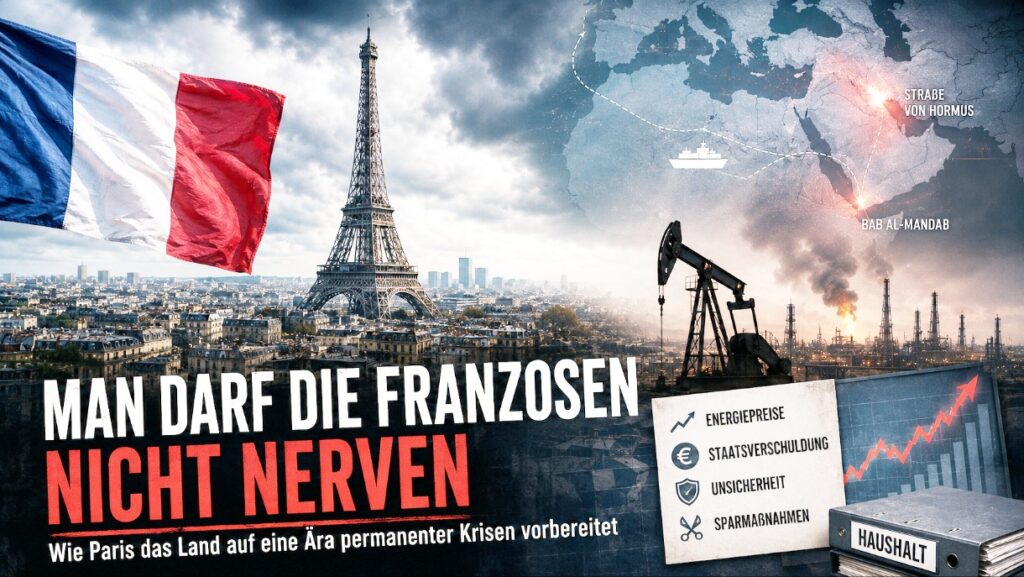
The phrase sounds casual, almost colloquial. “You must not burden the French any further” – that is what Prime Minister Sébastien Lecornu said when presenting new aid to counter rising energy prices following the escalation in the Middle East. In its apparent simplicity, this sentence reveals a surprising political shift in France.
Because Paris is visibly beginning to no longer prepare the population for a temporary crisis, but for a permanent state of emergency.
The French government now speaks with a sobriety about geopolitical risks that would have been unusual a few years ago. Lecornu openly stated that the conflict in the Middle East will continue “in one form or another.” Even under the most favorable conditions, some stabilization is expected only in the autumn. At the same time, the government warns of scenarios that until now have mainly been discussed in security think tanks: attacks on oil infrastructure, disruptions to maritime trade routes, possible blockades of the Strait of Hormuz or Bab al-Mandab.
This fundamentally changes the political tone in France. The government no longer tries to rhetorically conceal uncertainty. It is increasingly integrating it into official communication.
The new language of permanent crisis
The real significance of Lecornu’s statement therefore lies less in its content than in its political undertone.
“Do not annoy the French” in this context does not mean merely social consideration. It is the implicit recognition of a political vulnerability: the French state knows how quickly economic pressure can turn into open revolt.
The memory of the 2018 Yellow Vest protests is central. Few other events shook the French elite so profoundly. The movement was originally triggered by a relatively limited increase in fuel tax. But within a few weeks, it turned into a nationwide wave of protests against the loss of purchasing power, social inequality, and Emmanuel Macron’s technocratic leadership, perceived as arrogant.
Since then, a strategic dogma has become established at the Élysée: energy prices are no longer a purely economic issue, but a matter of domestic stability.
This is precisely why Lecornu rejects a general reduction in fuel taxes. Such measures would be popular in the short term but difficult to sustain fiscally over the long term. Instead, the government is focusing on targeted compensation for particularly exposed groups: commuters, healthcare workers, farmers, taxi drivers, and logistics companies.
This is politically highly significant. The French state is no longer trying to absorb crises completely. Rather, it is seeking to limit their disruptive potential within society.
France discovers the logic of crisis economics
This reveals a deeper shift in French state philosophy.
For decades, the French social model was based on an implicit promise: the state protects the population from the hardships of global markets. Financial crises, pandemics, or energy price shocks – Paris traditionally responded with massive interventions, price caps, subsidies, or public borrowing.
During the energy crisis following the Russian attack on Ukraine, this logic reached its temporary peak. France administratively capped electricity and gas prices, taking on costs amounting to billions in the state budget. Public debt rose further; it now clearly exceeds 110% of GDP.
But room for maneuver is shrinking. The combination of high interest rates, weak growth, rising defense spending, and structural deficits is forcing Paris to set priorities. The government can no longer fully neutralize every crisis.
This is why a new form of French crisis policy is now emerging: selective relief instead of universal guarantees.
This phenomenon does not concern France alone. A similar trend can be observed across Europe. States are trying to manage permanent burdens administratively rather than compensate for them in full. But in France, this strategy takes on particular political significance, because social expectations of the state are traditionally higher than in many other European countries.
The return of geopolitical realism
Also notable is the new frankness with which representatives of the French government are addressing geopolitical risks.
A few years ago, the idea prevailed in Europe that global economic integration had a stabilizing effect. Energy was regarded primarily as a market issue, not as a geopolitical vulnerability. This conviction dissolved at the latest with the war in Ukraine.
Now the conflict in the Middle East is once again exacerbating uncertainty. France is sending an indirect signal to the population: the era of predictable globalization is over.
Lecornu’s statements therefore fit into a broader strategic pattern. Europe is mentally preparing for a world in which supply chains are more fragile, energy will remain expensive, and geopolitical shocks will become more frequent.
There is also a second factor: strengthening defense. France is planning massive investments in defense, arms production, and strategic infrastructure. President Macron has spoken for years about Europe’s “strategic autonomy.” This line is gaining additional legitimacy from the current crises.
But armaments, energy security, and industrial resilience cost money. A lot. The political challenge is therefore to make this transformation socially acceptable.
The Psychology of Adaptation
This is precisely where Lecornu’s statement serves its main purpose.
The government is trying to walk a fine line: it must prepare the population for more difficult times without creating alarmism. It must convey seriousness without causing panic. And it must explain why, from now on, the state will no longer be able to fully offset every burden.
This explains the technocratic tone of government communication. The crisis is not dramatized, but managed. There is talk of targeted aid, burden-sharing, resilience, and adaptation.
This contains an implicit educational message: citizens must learn to accept uncertainty as a normal condition.
It is a political risk. Because France remains a country with a strong culture of protest and deep distrust of the elites. Any perception of social injustice can quickly become explosive. At the same time, the government seems convinced that it is no longer possible to return to the illusion of past stability.
The real message, therefore, is not: “The state protects you from the crisis.”
But: the state is trying to keep society governable in an age of permanent crisis.
This is a fundamental difference—and probably the real political turning point of this moment.
P.T.