
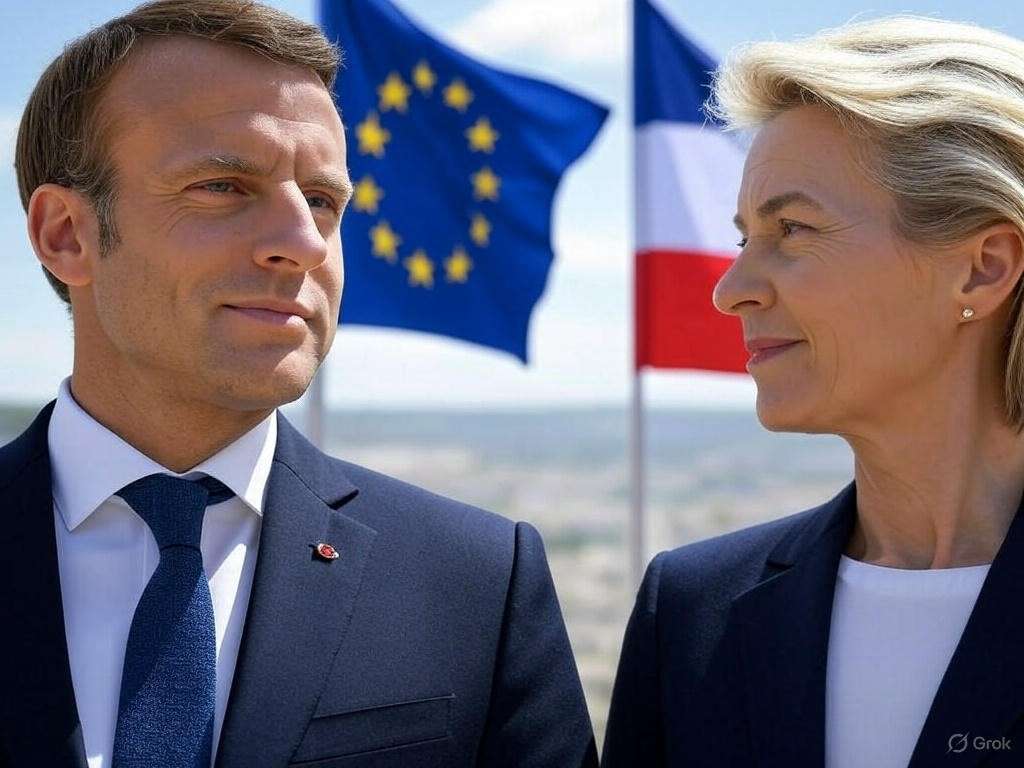
During his trip to Tokyo, Emmanuel Macron chose a phrase that at first glance seems sober, but upon closer examination represents a strategic signal: Europe is a “predictable” partner. In a phase of growing geopolitical tensions, this choice of words is anything but technocratic. It is an implicit distancing from Donald Trump – and at the same time an attempt to redefine Europe’s role in the international system.
Diplomacy in the shadow of an escalating crisis
The timing of this statement is no coincidence. The military escalation around Iran, as well as the increasing threat to key energy trade routes such as the Strait of Hormuz, have brought the international order into a phase of acute uncertainty. For Europe, this raises a fundamental question once again: how can its own security and economic policy interests be safeguarded without falling into a dangerous followership of Washington?
Macron uses this situation to emphasize a well-known but so far insufficiently realized concept: Europe’s strategic autonomy. His message in Tokyo was aimed at positioning the European Union as a predictable actor – as a counter-model to a US foreign policy that increasingly appears to be shaped by short-term, and thus unpredictable, decisions and domestic political dynamics.
The conflict with Washington as a catalyst
A trigger for Macron’s positioning was, not least, a renewed escalation in the transatlantic relationship. Trump had publicly criticized France and regarded its restraint in the current Iran conflict as a lack of support. The background is Paris’ refusal to fully support US military operations logistically or to expand their scope of action over European territory.
The French government, on the other hand, refers to a consistent line: no participation in military interventions without broad coordination with European partners and no automatic support of decisions made unilaterally in Washington. This stance is not new but gains additional political sharpness from the current crisis.
“Predictability” as a strategic category
The concept of predictability functions in Macron’s argumentation as a political guiding principle. This means not only stability in behavior but also reliability in fundamental principles: orientation to international law, multilateral coordination, and a gradual escalation logic.
This position addresses several audiences simultaneously. It signals independence to the USA without fundamentally questioning the alliance. To Asian partners like Japan, it aims to build trust – especially in a phase where economic and security risks are closely intertwined. And to the European member states, it is an appeal for unity.
Tokyo as a stage for geopolitical communication
The fact that Macron formulated his message precisely in Japan is strategically significant. Japan is one of the world’s largest energy importers and is particularly affected by instability in the Middle East. At the same time, the country is a key partner of Western democracies in the Indo-Pacific region.
By presenting Europe as a “predictable” and reliable actor, Macron seeks to strengthen trust in Europe’s role as a stabilizing force. This is not only diplomatically relevant but also economically: in a time of fragile supply chains and growing geoeconomic rivalry, political reliability becomes a location factor.
Europe’s internal contradictions
As convincing as the rhetoric appears, the structural weaknesses of Europe also become clearly apparent. Member states pursue different approaches to dealing with the current crisis. While France relies on strategic distance from the USA, other countries show a greater willingness for transatlantic cooperation – whether out of security policy conviction or due to limited own military capacities.
These divergences relativize the claim of European predictability. Because reliability requires not only consistent principles but also the ability to act coherently. This is exactly where the greatest challenge of European foreign policy lies so far.
Transatlantic Relations in Transition
The tensions between Washington and European capitals are an expression of a deeper shift. Under Trump, American foreign policy has become more focused on national interests and short-term objectives. Multilateral institutions and traditional alliances are losing importance, while bilateral power politics gain weight.
For Europe, this means a strategic turning point. The previous security architecture, which relied heavily on the reliability of the USA, is faltering. At the same time, pressure is growing to expand own capabilities – militarily, economically, and diplomatically.
Between Ambition and Reality
Macron’s intervention in Tokyo is therefore more than a rhetorical exercise. It is part of a larger attempt to establish Europe as an independent geopolitical actor. The French president correctly recognizes that the current unpredictability of American politics opens a time window in which European initiatives can gain weight.
However, there is still a gap between diagnosis and implementation. The European Union so far lacks both the institutional cohesion and the operational means to fully realize its strategic ambitions. Defense policy cooperation, common foreign policy, and economic resilience remain unfinished.
Macron’s concept of “predictability” is therefore ambivalent. On the one hand, it describes a real strength of Europe – its institutional stability and normative orientation. On the other hand, it conceals the deficits in capacity to act. In a world of increasing power competition, however, it is not enough to be predictable. What matters is whether this predictability is also accompanied by decisiveness.
The coming months will show whether Europe can fulfill this claim. If it succeeds in consolidating its own position and developing concrete political instruments, the current crisis could indeed become a turning point. Otherwise, Macron’s formula remains an apt description – but not a strategic breakthrough.
Author: P. Tiko