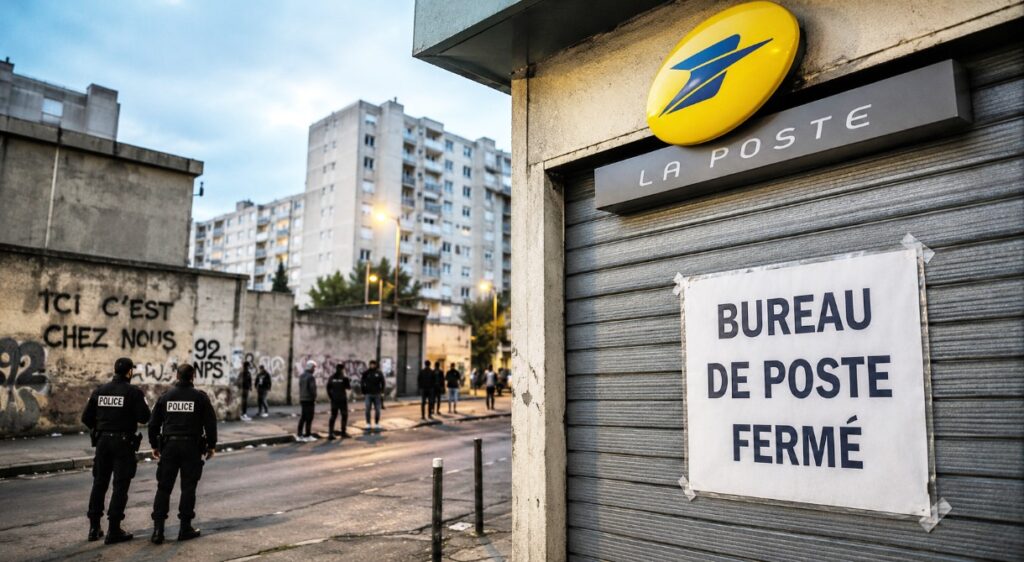
In Nîmes the anger of many residents is currently flaring up around a building that initially seems inconspicuous: a closed post office. But behind the locked doors lies much more than the end of an administrative service. For many people in the neighborhood, the closure marks a new withdrawal of the government — and at the same time the rise of those forces that have long shaped daily life: drug gangs, violence, and intimidation.
Especially in socially weaker districts such as Pissevin or Valdegour, a mixture of fear, frustration, and fatigue has been brewing for years. Many residents openly express that their neighborhood is gradually being left to the networks of drug trafficking. What once seemed like an exaggerated headline has by now become almost daily fare there.
The post office was seen by many residents as the last neutral place.
Seniors picked up their pension papers there, families made transfers, people without safe internet access received help with forms or official letters. But above all, the building stood for something larger: visible government presence. For order. For normality.
When such a place disappears, it is not just a lack of services that remains. A vacuum is created.
And it is precisely into these voids that criminal networks penetrate. Residents talk about dealers near entrances, young people being used as lookouts, and nighttime shootings that no longer wake anyone up. Some parents only bring their children to school using detours. Shops close earlier. There is a silent tension in the streets that you can almost feel.
“Everyone used to know each other here,” says a shopkeeper. “Nowadays people prefer to look the other way.” A statement that lingers.
The situation in Nîmes is exemplary of a development that no longer concerns only large cities like Marseille. Drug trafficking has spread across many medium-sized French cities. Professionally organized, brazen, and economically lucrative. Researchers now speak of structures that almost function like companies — with clear hierarchies, territorial control, and enormous intimidating power.
The government usually responds with police actions, raids, and short-term security measures. In Nîmes as well, there have recently been intensified controls and even a curfew for minors in particularly burdened neighborhoods. But many residents say openly: that is far from enough.
Because safety arises not only through police patrols.
Safety arises where schools function well, where doctors stay, where shops are open, and public services are visibly present. And that is lacking in many places. When libraries close, clubs disappear, and even the post office no longer remains, neighborhoods lose their social cohesion.
Then others take control.
Not officially. But perceptible.
The closed post office of Nîmes has long been more than just a local news item. It symbolizes the question of how much withdrawal a state can afford before entire neighborhoods lose trust. And regaining that trust — that is clearly more difficult than reopening a door.