
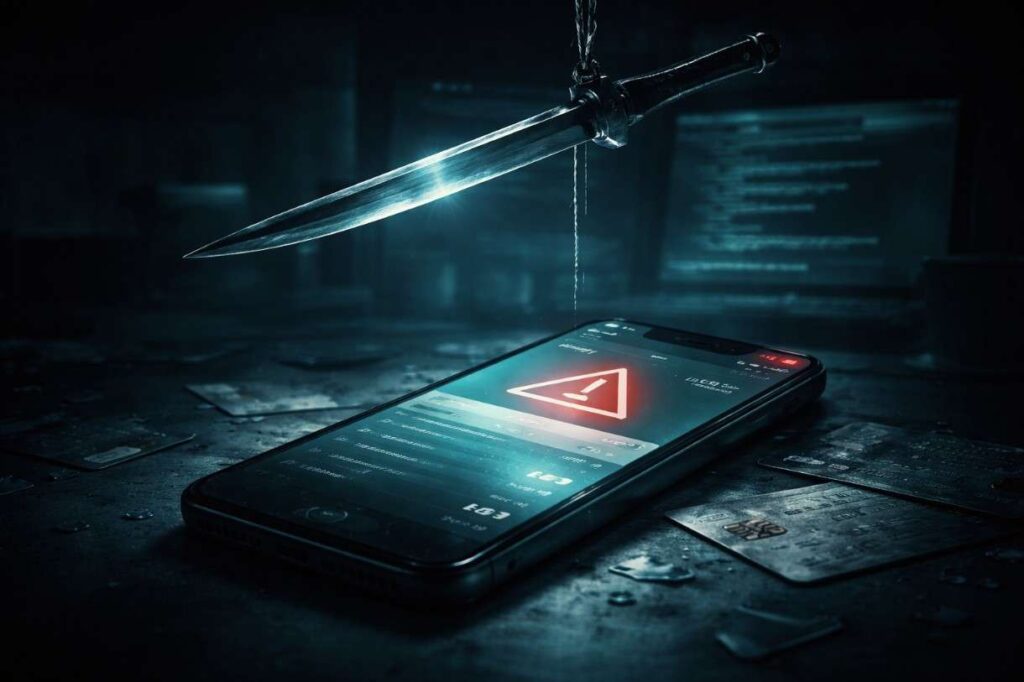
It’s not the moment when the money disappears.
It’s the moment after.
The moment you open your account and feel that something is wrong. No loud bang, no visible break-in – just numbers that are no longer your own. And suddenly that one question is in the room, quiet but relentless: If this is no longer safe – what is?
Bank data hacks are not just technical incidents. They are violations. Silent, invisible, but deeply cutting.
Because what is stolen here goes far beyond money. It is trust. It is control. It is the feeling of having your life under control.
And that’s exactly what makes them so insidious.
We have grown used to digitizing our lives. With a familiarity that almost seems naive. One click here, one confirmation there – and everything runs. Rent, salary, shopping. It’s convenient. Fast. Efficient.
Until it breaks.
Then that convenience turns into its opposite. Every click becomes a test. Every message a potential attack. The smartphone, moments ago a tool, becomes a factor of insecurity.
And suddenly you live with this latent fear.
Like an invisible threat that can return at any time.
The real drama doesn’t begin with the fraud – but after. When cards are blocked, passwords changed, maybe even the money refunded. Formally everything is settled.
But internally?
Nothing is the same as before.
You check your account – once, twice, five times a day. You hesitate with every online payment. You read every bank message three times, looking for mistakes, for clues, for that one detail you might notice this time.
And at some point you ask yourself: When will this stop?
The honest answer is uncomfortable.
It doesn’t just stop.
Because the damage runs deeper. It eats into routines, into habits, into that fragile basic trust we need to be able to live digitally at all.
And then there is that feeling many do not want to speak aloud.
Shame.
Yes, exactly that.
Because you think you could have prevented it. Because you wonder whether you were careless. Because you — completely unjustly — make yourself part of the problem.
But the truth is different.
These attacks are highly professional. They are designed to deceive. They exploit weaknesses that are not in people, but in the system. In a digital infrastructure that often promises security but does not always deliver.
And yet responsibility all too often ends up falling on the individual.
“Why did you click?”
“Why did you confirm that?”
These questions are not only inappropriate – they are cynical.
Because they fail to recognize the real problem: We live in a world that forces us to participate digitally without adequately protecting us.
That is the core.
We cannot expect millions of people to act like IT security experts every day. That they recognize every deception, avoid every trap, anticipate every uncertainty.
That is simply unrealistic.
And honestly: unfair, too.
What is missing is not just better technology. It is attitude. Responsibility. A system that does not leave people alone with their fear.
Because that is exactly what is happening right now.
The victims are often left alone – between hotlines, forms and vague promises. They fight not only for their money, but for a piece of normality.
And they rarely get that back.
Maybe it is time to change the perspective.
Not the question “How could this happen?” should be at the forefront.
But: “Why do we allow it to happen again and again?”
Because as long as nothing changes about that, this feeling remains.
That quiet, gnawing knowledge that somewhere someone could have access. That a single moment is enough to throw everything into turmoil again.
And that is what truly remains.
Not the financial damage.
But this constant tension. This mistrust. This uncertainty that cannot be shaken off.
A life with an invisible threat.
Like a shadow that simply will not disappear.
M.A.B.