Back

Nachrichten.fr · May 29, 2026

Age verification through hand movement: French startup bets on new technology

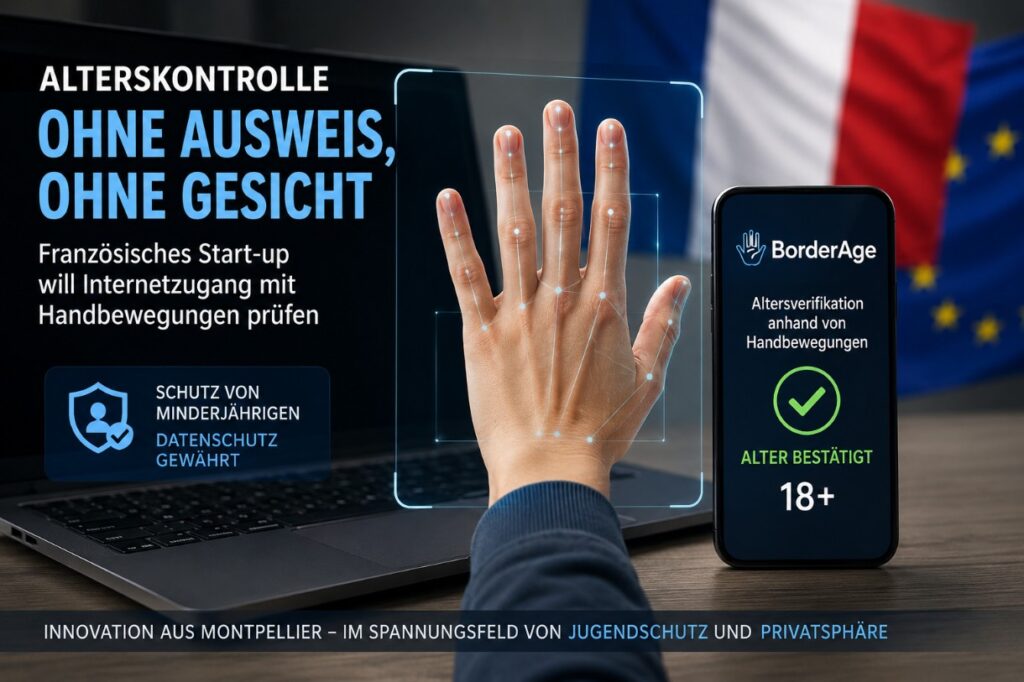
How to verify the age of an Internet user without uploading identity documents, revealing personal data, or resorting to facial recognition? This is exactly the question currently being worked on by the company Needemand from Montpellier. The young enterprise has developed a technology that controls access to online content based on micro-movements of the hand, an approach that seems as unusual as it is ambitious.

The solution is called BorderAge. Users place their hand in front of the smartphone or computer camera. Subsequently, the software analyzes the minimal movements and motor patterns that should be typical of different age groups. According to the company, this makes it possible to determine whether a person exceeds a certain minimum age. No identity document, selfie, or biometric facial recognition is necessary.

The timing for this innovation could not be more sensitive.

France and the European Union are currently intensifying efforts to make it harder for minors to access social networks, gambling, and especially pornographic content. Legislators and regulatory authorities are seeking effective solutions without violating users’ privacy. It is precisely at this point that BorderAge comes in.

Privacy experts face a difficult balance. On one hand, political pressure is increasing to better protect children and adolescents from inappropriate content. On the other hand, there is a desire to avoid millions of citizens having to transmit sensitive personal data to platforms or third parties. For this reason, systems that operate as anonymously as possible but function reliably are particularly interesting.

Needemand promises exactly this approach. The technology is supposed to detect only an age category and not the identity. For users, this could mean the advantage of proving legal age without leaving digital traces in the form of copies of documents or biometric data.

It almost seems a bit like science fiction.

However, some questions remain open. The company cites a very high recognition accuracy and, during a hearing at the Canadian Senate, also spoke of success rates up to 99%. These values would be remarkable, especially considering that the analysis is based solely on hand movements. So far, however, widely known independent studies confirming these claims comprehensively are not available.

BorderAge therefore represents an example of a development that should play an increasingly important role in the coming years: age verification on the internet must be at the same time secure, privacy-respecting, and as simple as possible. Whether the analysis of micro-movements of the hand will actually become the new standard will ultimately depend not only on technical capability but also on the trust of authorities, platforms, and users.

Author: Christine Macha