
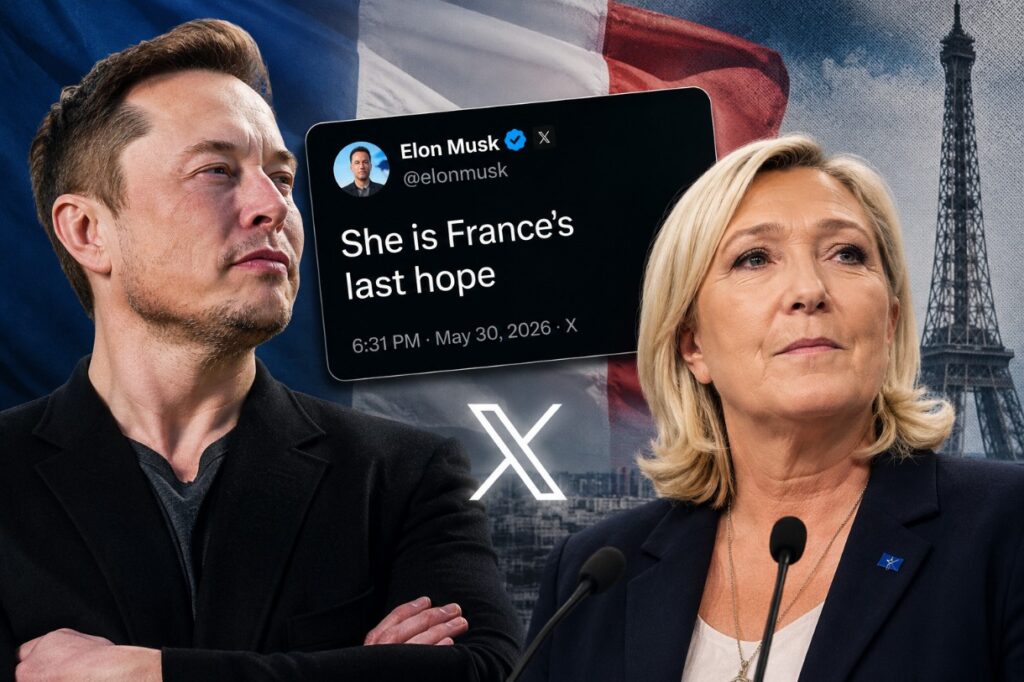
With a single sentence, Elon Musk has once again sparked a political debate far beyond the borders of the United States. On his platform X, the entrepreneur described Rassemblement National leader Marine Le Pen as ‘France’s last hope.’ The brief message is part of a series of political statements by the tech billionaire, through which he is increasingly intervening in European election campaigns and domestic political debates.
A sentence with major political impact
The controversy was triggered by a post on X pointing to Marine Le Pen’s rising poll numbers ahead of the 2027 French presidential election. Elon Musk responded with the words: ‘She is France’s last hope’ – in German: ‘Sie ist Frankreichs letzte Hoffnung.’
Although Musk did not elaborate on his statement, it was widely understood as clear public support for the Rassemblement National politician. The entrepreneur refrained from offering a detailed political analysis and limited himself to a brief reply. Yet it was precisely this brevity that gave the remark particular attention, as it was unmistakably interpreted as a personal endorsement.
Criticism over possible interference
Reactions in France were not long in coming. Representatives of various parties accused Musk, as a foreign billionaire, of interfering in the French democratic process. Particularly in view of his enormous reach on the X platform he controls, critics see this as more than an ordinary expression of opinion.
The debate touches on fundamental questions about the influence of global technology entrepreneurs on democratic decision-making processes. While politicians have traditionally sought the support of prominent figures, Musk’s influence takes on a new dimension because of his economic power and his direct control over one of the world’s most important communications platforms.
Part of a broader political strategy
Support for Marine Le Pen is not an isolated case. In recent years, Musk has repeatedly spoken in favor of conservative and right-wing parties as well as individual politicians in Europe. His comments on German and British domestic politics in particular have regularly made headlines.
Musk is thus pursuing a communication style that differs markedly from that of traditional business leaders. Rather than exercising political restraint, he actively uses his platform to advocate political positions, influence public debates and publicly support candidates.
His remarks often reach millions of users worldwide within just a few hours and are picked up by traditional media, further expanding their reach.
Mixed reactions within Marine Le Pen’s circle
Interestingly, Musk’s support is not seen as an advantage by everyone in Marine Le Pen’s circle. French media report that some Rassemblement National strategists view the US entrepreneur’s open endorsement with caution.
The reason lies in how French voters perceive the issue. While Musk is internationally associated with innovation and economic success, he is also polarizing because of his controversial statements on politics, migration, regulation and social issues. An overly close association with him could therefore alienate parts of the French electorate.
In presidential campaigns especially, candidates traditionally seek to emphasize their independence from foreign influencers. Open support from abroad can therefore be as much a liability as an advantage.
The role of social networks in democracy
The incident highlights a fundamental shift in political communication. Social networks now enable individual entrepreneurs, investors and prominent figures to exert a direct influence on national election campaigns. The boundaries between private expression of opinion, political influence and media agenda-setting are becoming increasingly blurred.
Platforms with hundreds of millions of users in particular are developing into political arenas in which international actors can influence debates within sovereign states. The question of whether this represents legitimate freedom of expression or problematic interference has been intensely debated in Europe for years.
Musk’s support for Marine Le Pen gives this debate renewed relevance. Regardless of what influence individual posts actually have on election results, the case shows how deeply social media and their owners have become involved in political processes.
Whether Musk’s words will have long-term effects on the French presidential campaign remains unclear. What is certain, however, is that his statements regularly generate international attention and continue to fuel the discussion about the influence of digital platforms on democratic systems. French politics is thus emblematic of a development that extends far beyond the country’s borders: national elections are increasingly being followed on global communications platforms – and sometimes commented on by actors who are not themselves part of the respective political system.
Author: P. Tiko