
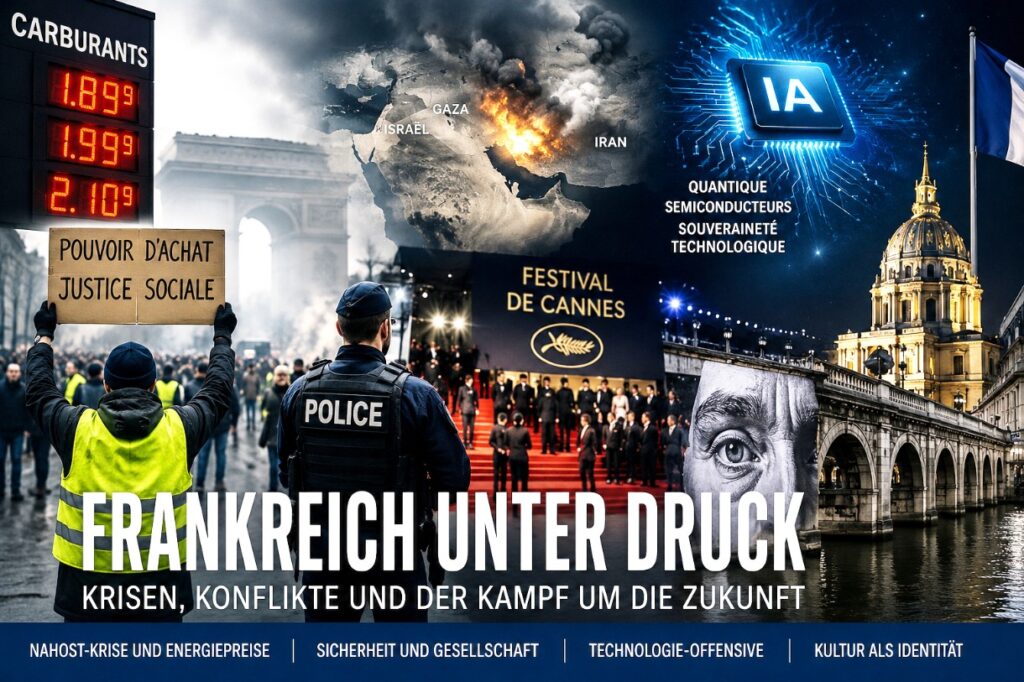
On May 23, 2026, the French media report on the state of a nation constantly on high alert. Almost every sector—foreign policy, energy prices, security, technology, social polarization, cultural symbolic politics—is not free from crisis issues, and these interact to create a remarkable simultaneity of tension. France seems less like a country in acute panic than a collective of citizens accustomed to a continuous state of uncertainty.
Fear of a New Social Explosion
At the core of the reports remains the escalating geopolitical tension in the Middle East and its economic repercussions in Europe. French media are especially focused on the soaring energy and fuel prices once again. President Emmanuel Macron’s government clearly shows efforts to mitigate social aftereffects early on. New support programs for transportation, agriculture, commuters, and small businesses are interpreted as preventive crisis responses rather than traditional social welfare measures.
The historical shadow of the “Yellow Vest” movement still lingers. Several commentators remind that the 2018 Yellow Vest protests originally ignited due to rising fuel prices. At that time, opposition to tax policies quickly evolved within weeks into nationwide riots opposing loss of purchasing power, resentment toward elites, and social marginalization.
The current situation appears more complex. France is simultaneously experiencing low growth, increasing national debt, geopolitical instability, and a general unease about economic vulnerability. Several editorials now frankly mention the ‘économie de guerre larvée,’ that is, an undeclared latent wartime economy situation, assessing that this logic is increasingly influencing political daily life.
The Mirror of a Tense Nation, the Cannes Film Festival
At the same time, concerns about security are once again at the center of the news. The Cannes Film Festival, which ends today, is interpreted not just as a cultural event but increasingly as a socio-political symbol.
Reports about luxury watch thefts, organized crime groups, reinforced police deployment, and extensive security measures around the Croisette dominate the coverage just as much as the films themselves. The glamorous Cannes is seen by many commentators as not only internationally renowned and culturally significant, economically attractive, but also as a microcosm of France where tension, social division, and constant surveillance coexist.
The security debate points to deeper issues. France is one of the countries in Europe particularly sensitive about public order. In recent years, terrorist attacks, urban violence, organized crime, and social unrest have shaped the atmosphere permeating political discussions everywhere.
It is described in many media outlets that the fact that even film festivals are effectively held under high security conditions is not an unusual event but a new normal.
France’s War to Secure Technological Sovereignty
Another major issue in the French media is strategic technology policy. While the presidential office is making investments worth billions of euros in artificial intelligence, quantum research, and semiconductor production, analyses expressing concerns that Europe could continuously fall behind technologically in the global competition between the US and China are pouring out.
France aims to position itself as the driving force of European technological sovereignty. In particular, economic newspapers openly mention that the global ‘tech war’ surrounding AI infrastructure, data centers, chips, and control of data flows is understood as a new form of geopolitical power.
Paris, on one hand, strives to attract international investors, while on the other, pursues a dual strategy to protect strategic core industries at the national level. This is connected to the tradition of French dirigisme in the economy that has lasted for decades since World War II, but today is being pursued under much more difficult global conditions.
This anxiety is clear. Numerous analyses warn that Europe is increasingly at risk of depending on American and Asian companies in AI applications, cloud infrastructure, and semiconductors. France considers this not just an economic risk but a matter of national sovereignty.
Polarization and Rigidity of Public Climate
Social tension issues also remain. After racist threatening letters and threats at the Agen, many media outlets focus on the increasingly harsh atmosphere in public discourse. This debate is spreading beyond individual incidents.
Several commentators point out that French society is undergoing structural polarization. Political camps are growing further apart, and social networking services play a role in intensifying emotions and radicalization. Furthermore, deep institutional distrust of political parties, media, and state authority is also spreading.
France exhibits these tendencies as seen in other Western democracies, but due to its conflict-laden political culture, it shows particularly severe patterns. The tradition of intense ideological struggle, from the French Revolution through 20th-century class struggles to today’s identity debates, further deepens social tensions.
Several newspapers openly question whether France has entered a stage of domestic instability in which crisis becomes a sustained baseline rather than an exception.
Culture Contrasting the Crisis
At the same time, cultural self-presentation remains a core element of French identity. The dramatic transformation of the Pont Neuf completed by the artist JR and the worldwide attention surrounding Cannes demonstrate France’s aspiration to maintain a cultural presence on the global stage.
Especially in times of crisis, the cultural stage plays a special role for France. It functions as a means to confidently reaffirm national significance beyond simple entertainment. Art, architecture, film, and public symbols indirectly become part of a political strategy of cultural resilience.
However, what stands out is that even these cultural themes are now rarely discussed separately from security, identity, and social issues. Culture is increasingly perceived not as a counterpoint to the crisis but rather as its mirror.
The tone of the French media this Saturday is noticeably sober overall. Optimistic elation or progressive optimism is rare; instead, it is dominated by the nation’s sentiment of continuously responding to economic, geopolitical, technological, and social uncertainties simultaneously.