La traduzione live è in corso ...
Nachrichten.fr · May 22, 2026
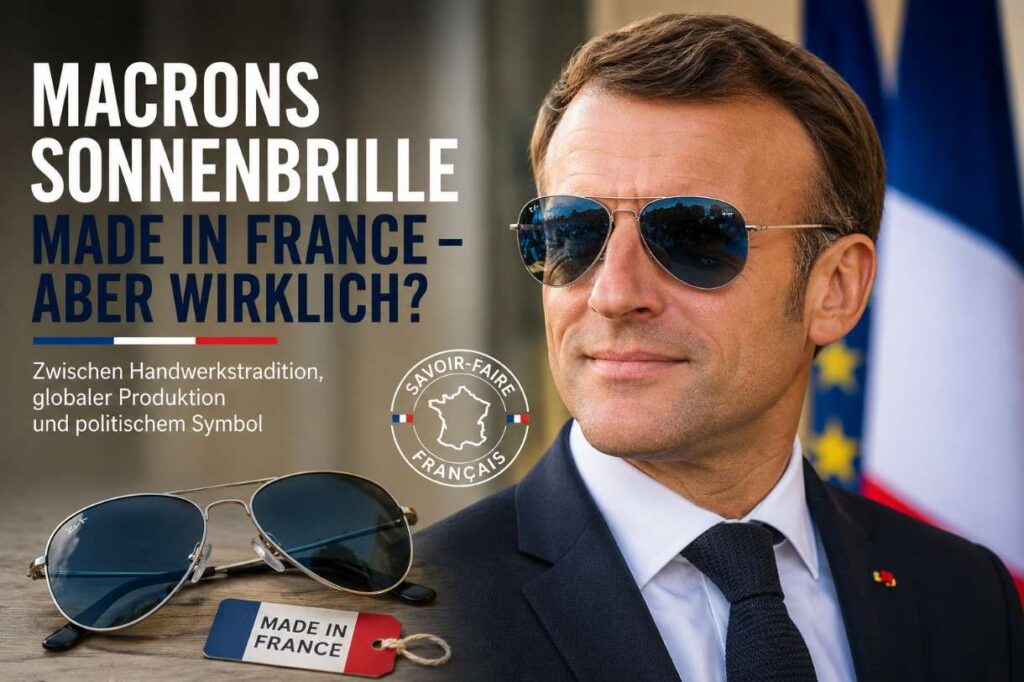
Macron’s Sunglasses and the Enigma of “Authentic” Made in France When President Emmanuel Macron stepped onto the balcony of the Élysée Palace last week wearing mirrored aviator sunglasses, the photo spread across newspapers and social media. The image fit perfectly into the French president’s carefully managed sporty and modern persona. But beyond the staged charisma, the sunglasses sparked an unexpectedly heated debate: were they truly “Made in France”? The question may sound trivial, even absurd. Yet it cuts to the heart of a larger political and economic discourse in France: what does it mean for a product to be authentically French in an era of complex global supply chains? The spectacle around Macron’s sunglasses reveals how symbolic goods become battlegrounds for identity, protectionism and credibility. Initial investigations revealed that the frames were produced in France, while the lenses were manufactured abroad and later assembled domestically. That is a common configuration in many industries: parts cross borders several times before a final product is labeled as national. But for many commentators and politicians, the label “Made in France” implies a fully domestic origin — everything from design to raw material extraction to final assembly. The discrepancy between expectation and reality is used by opponents to question Macron’s commitment to national production and by supporters to argue that he promotes French craftsmanship at least where it counts. Beyond the presidency, the case raises real questions for policymakers. If consumers and voters demand more transparent origin labels, legislators need to define precise criteria. Some propose a points-based system based on production steps carried out domestically; others advocate stricter rules like minimum domestic value added. But any tightened definition would have consequences: increased prices for consumers, potential retaliation from trade partners, and challenges for companies that rely on international suppliers to remain competitive. There is also a symbolic dimension: in a country where public figures are expected to embody republican values, the material origins of a president’s accessories take on outsize significance. Sunglasses are a small item, but they can become a litmus test about whether the rhetoric of supporting national industry is more than cosmetic. The debate shows how politicized consumption has become. Finally, the episode highlights a broader European dilemma. Many countries are trying to reshore strategic production for economic security, yet complete autarky is neither feasible nor desirable. The goal should be resilience and fair transparency — citizens should know what “Made in” means and governments should support realistic paths to strengthen domestic capabilities without retreating from necessary international cooperation. Macron’s sunglasses will likely disappear as a topic soon, replaced by another image or controversy. But the questions they raised about authenticity, policy and national identity will remain. If the president wants to turn the discussion into durable policy, he will need more than symbolic gestures; he will have to propose concrete rules and incentives that reconcile French pride with the realities of a globalized economy.