
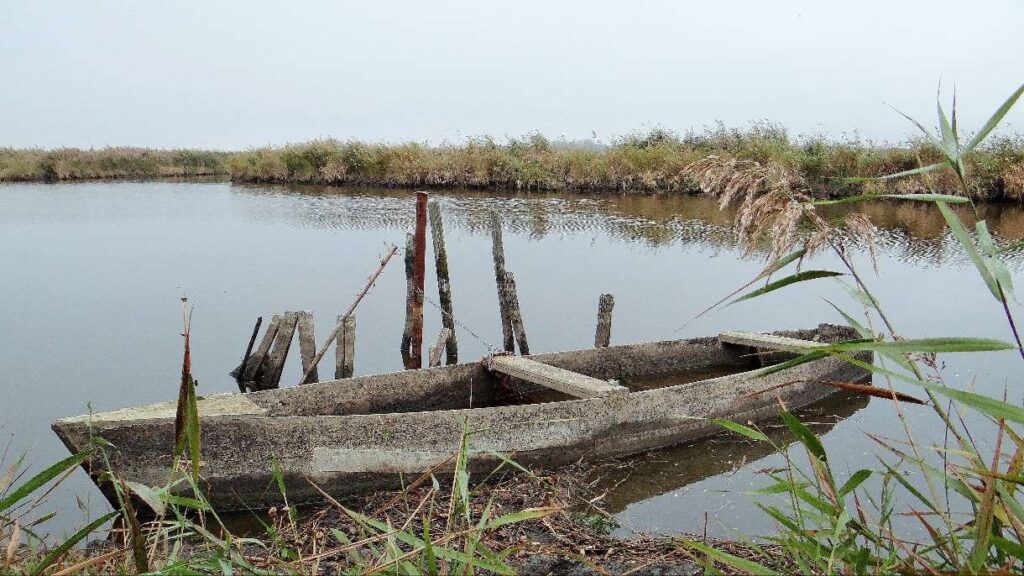
France loves grand gestures. Fields of lavender roll like backdrops through Provence, the Atlantic coast presents itself with rugged elegance, Paris sells its boulevards as eternal promises. And then there are places like the Grande Brière — landscapes that make no sound. They simply exist. Wet, dark, quiet. Almost defiantly unspectacular. Precisely for that reason they draw people like a magnet.
To the west of Saint-Nazaire begins a world that feels more like a forgotten chapter of Europe than a classic travel destination. When you boat through the canals of the Marais de la Grande Brière early in the morning, you initially see almost nothing. Mist hangs over the water like an old curtain. Reed rustles softly. Now and then a bird sounds the alarm. Then suddenly a flat, black boat glides out of the mist — silent, almost ghostly.
You involuntarily wonder: how many such landscapes still exist in Europe?
The Grande Brière is among the largest marsh areas in France. But numbers mean little here. The feeling remains decisive. That peculiar suspension between water and land. Between present and past. The region has something archaic, as if modern times have barely touched it.
For centuries the inhabitants lived almost exclusively from what the marsh offered. Fish, peat, waterfowl, reed. Not an easy life – rather a continual engagement with wind, humidity and patience. The peat was used for heating, the reed covered the roofs, the canals replaced the roads. Even now many houses are hidden under thick thatched roofs, as if they want to be exposed as little as possible to the attack of the Atlantic wind.
Some villages seem to have survived from another time by chance.
Above all Saint-Joachim possesses that quiet singularity. Not a picturesque museum village, not a neatly restored open-air idyll. Rather a place where the past simply continues to live without making much fuss about it. Boats stand in front of the houses instead of garden gnomes. Old men repair nets. Curtains hang behind windows that probably already knew the grandmothers. That sounds more romantic than it actually was before. The Brière meant hard work. Moisture crept into bones and walls alike.
And yet from that arose a quirky culture.
Also culinary.
The eel here, for example, has almost mythical status. “Anguille en persillade” – eel with parsley and garlic – is still one of the region’s specialties. A rustic dish, robust, oily, intense. Not for those who want to nibble cautiously at their food. The eel seems to writhe through the whole history of the Brière. Fishers chased it at night through narrow canals, often in bad weather, sometimes for hours. Those who succeeded brought home more than just food. A good catch meant security.
Today small restaurants serve the old recipes with a glass of white wine from the Loire Valley. It’s a bit like a culinary time travel – and also an act of resistance against the uniformity of modern cuisine.
But the real secrets lie deeper.
Beneath the marsh rest remnants of primeval forests. Peat diggers repeatedly bring black oak trunks to light, preserved by the oxygen-poor soil for thousands of years. These dark giants of trees seem almost unreal, like relics from a sunken world. When you stand by them, you suddenly feel the dimension of time. Not the hectic time of smartphones, but geological time – slow, heavy, relentless.
Archaeologists have discovered tools in the region, traces of habitation and evidence of very early human use. In this way the Brière also tells climate history. Where water surfaces now glitter and reed dominates, forests once stood. The marsh became a kind of natural memory of Europe.
No wonder then that scientists now look more closely. Marshlands store huge amounts of carbon, regulate water balance and protect biodiversity. In the past swamps were often seen as useless or dangerous. Nowadays they suddenly seem like ecological treasure troves. Well – sometimes humanity needs a few centuries to realize what’s right under their noses.
The animal world of the Grande Brière reinforces that impression. Herons stride through the shallow water like bored aristocrats. Greylag geese circle above the reeds. Cormorants sit with outstretched wings on posts, seeming like dark priests of some water cult. In spring the marsh nearly bursts with sounds. Frogs croak, insects buzz, birds cackle together. Sometimes the landscape sounds more like the Amazon than like western France.
And that is precisely where its beauty lies.
The Grande Brière resists the fleeting glance. You don’t just drive through it to tick off sights. This landscape demands slowness. Silence. Attention. Those constantly looking for the next photo moment will likely miss the essential.
Perhaps that is why the region remains relatively unknown. It lends itself poorly to the logic of modern travel checklists. No big spectacle. No monumental castle. No “Instagram spot” where people queue up. Instead there is mist, water, wind and time.
Is that enough?
Surprisingly enough: yes.
Because the Grande Brière evokes something that has become rare in Europe — the sense of untamed nature. Of places that have kept their mysteries. While elsewhere everything seems explained, signposted and commercialized, here a remnant of mystery remains.
And perhaps that is precisely its greatest luxury.
An article by M. Legrand