
Back

Nachrichten.fr · 05/23/2026

When the City Finally Goes Dark

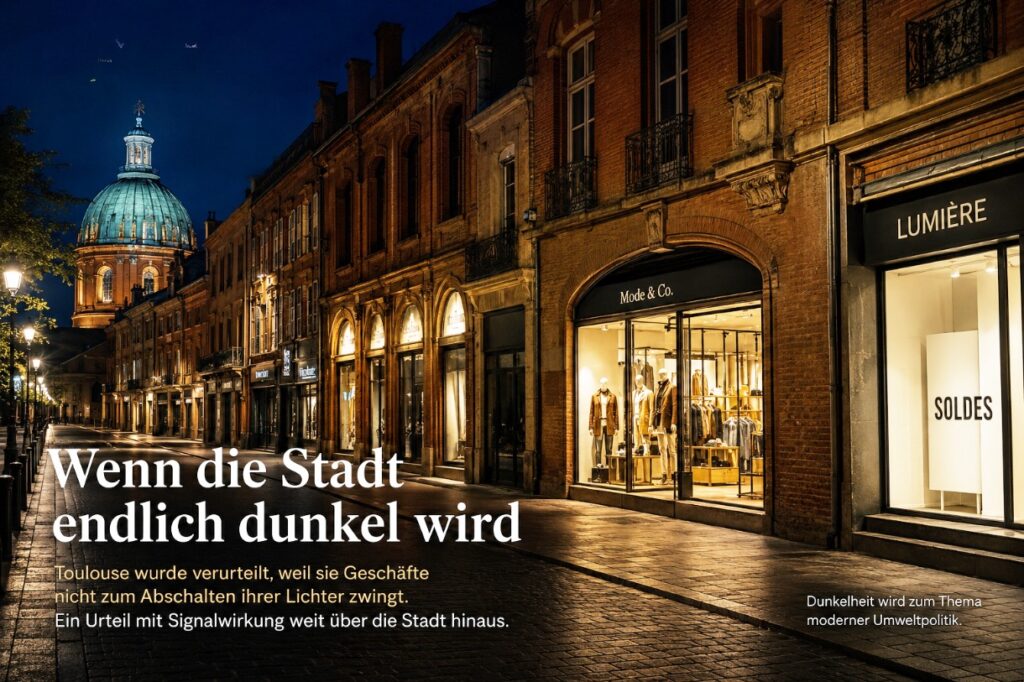
Toulouse loves to shine. The pink facades of the southern French metropolis glow at night like the sets of an old film, cafés cast warm light onto the alleys, shop windows gleam late into the night. Anyone walking through the old town immediately senses this urban promise: Nothing sleeps here. Life pulses here.

And therein suddenly lies the problem.

Because now an administrative court has condemned the city — not due to a spectacular scandal, not because of corruption or mismanagement, but because of too many burning lamps. Toulouse had not sufficiently obligated its businesses to switch off their lighting at night. An almost inconspicuous verdict. And perhaps precisely for that reason, one with explosive potential.

It seems like a dispute over neon tubes and shop windows. In fact, the case tells of a profound cultural change. France is beginning to rethink. The night, long the stage of modernity, is slowly transforming into a political space.

For a long time, light was considered progress. The brighter a city, the more modern it appeared. Those lying in darkness at night seemed provincial or poor. Paris did not earn the nickname “Ville Lumière” by chance. Light meant safety, elegance, prosperity. It was the glow of department stores, boulevards, the Republic itself.

Today, this old certainty suddenly sounds a little outdated.

Because artificial continuous light now has a second meaning: energy consumption, environmental impact, disruption of natural rhythms. Insects die on illuminated facades. Migratory birds lose orientation. People sleep worse. Even trees get confused by permanent brightness—as if the city had decided not to grant the seasons a rest either.

And so something remarkable begins: darkness gains a new value.

Not romantically idealized as in 19th-century poetry, but administratively, ecologically, almost technocratically. Suddenly, mayors are discussing switching times. Authorities monitor illuminated advertisements. Environmental groups roam city centers at night with cameras like detectives of an over-illuminated civilization.

One has to imagine this: activists documenting illuminated boutiques at two in the morning. It almost seems like a scene from a quiet French comedy.

But behind the absurdity lies seriousness.

The real question is: How much brightness does a society that never stops need?

Modern cities live on visibility. Restaurants want to attract guests. Stores compete for attention. Tourism demands atmosphere. Light stages consumption like theater. A dark shopping street immediately appears deserted, perhaps even threatening. That is exactly why many municipalities shy away from strict controls—no one wants to watch city centers fade away.

But at the same time, the moral climate is changing.

What was once considered lively now sometimes appears wasteful. The brightly lit luxury facade now sometimes carries something anachronistic, almost defiant. As if it wants to say: We will continue as before. No matter how high electricity prices rise. No matter how often climate change is talked about.

The verdict against Toulouse thus hits a sensitive nerve. It forces a city to actively act against its own lighting culture. Not voluntarily. Not symbolically. But legally binding.

And perhaps this is exactly where the real shift begins.

Because laws against light pollution have existed in France for some time. What is new is the political will to take them seriously. For decades, many rules remained rather decorative—like traffic signs on deserted country roads. Now the judiciary suddenly discovers its enforceability.

Other cities are likely to pay close attention. Marseille. Lyon. Nice. Everywhere nighttime brightness is part of city marketing, the risk of similar proceedings now grows. This could trigger conflicts. Retailers are already warning of security problems and declining attractiveness. Environmental groups, on the other hand, smell a historic lever.

It is no longer just about lamps.

It is about the question of what image modern cities want to project of themselves. Continuously lit, consumer-oriented, permanently visible? Or more conscious, economical, perhaps even quieter?

Anyone walking through a truly dark street at night quickly notices: darkness has its own dignity. Sounds change. Facades disappear. The sky reappears. Suddenly, you see stars above the city—an almost forgotten experience. Crazy, really, isn’t it?

Perhaps therein lies the true punchline of this ruling. That precisely an administrative decision about shop window lighting reveals something much bigger than municipal law. A cultural shift in mood.

The modern city is slowly learning that not every light means progress.

And that sometimes a society becomes sensible exactly where it is willing to turn off the neon.

An article by M. Legrand