
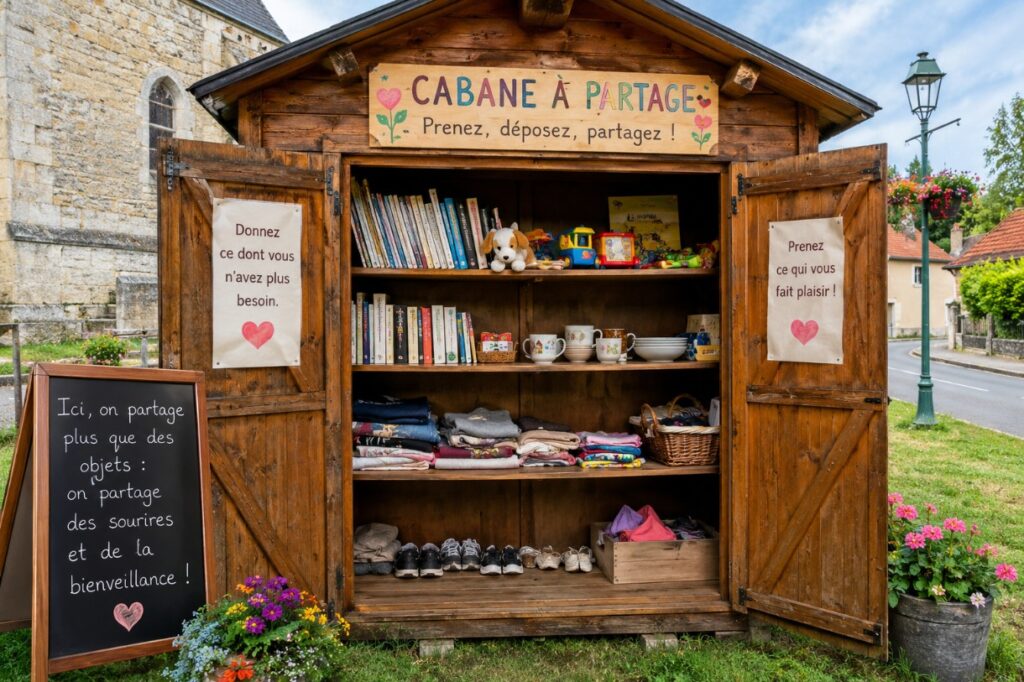
In many villages across France, a quiet little revolution is currently taking place. No grand political debates, no multimillion-euro funding programs — just a simple wooden hut by the roadside. In Canaples, a small community in the Somme department with around 700 inhabitants, it has been evident for two years how powerful an idea can be that is actually very old: share instead of throw away.
The so-called “Cabane à partage” (sharing hut) looks unassuming at first glance. Anyone who opens the door finds books, toys, dishes, clothing, or small pieces of furniture. Items from apartments, basements, or attics that no longer have a place for their owners but suddenly become valuable to others. Everyone can bring something. Everyone can take something. Free of charge. Without registration. Without any control.
It is precisely this uncomplicated nature that gives the project its charm.
While in many places there is much discussion about loss of purchasing power, rising prices, and consumption stress, Canaples has long been practicing a very down-to-earth response. The small hut works like a village promise: people simply trust each other. No security personnel, no forms, no bureaucratic fuss. It almost sounds a bit crazy — but it works surprisingly well.
Anyone who has visited such places quickly realizes: it’s no longer just about old belongings here.
Suddenly, an elderly gentleman stands in front of a box of children’s books, telling how the same stories used to be in his daughter’s room. Two young parents are delighted about a high chair that would otherwise have been expensive to buy. A neighbor discovers a lamp and laughs, saying, “It fits perfectly in my kitchen — made for it.”
This is how conversations arise that have become rare in many villages.
Because especially in rural France, meeting places have been disappearing for years. Small shops close, cafés struggle to survive, post offices are being reduced. Social life is increasingly shifting to the private sphere. The “Cabane à partage” therefore almost incidentally assumes a new role: it becomes a meeting place.
And perhaps this is precisely its true strength.
France has been experiencing a cultural shift in consumption behavior for some time now. Terms like “anti-gaspillage” — the fight against waste — have become a regular part of everyday social life. Flea markets, repair cafés, and secondhand platforms are booming. The small exchange huts fit perfectly into this development. They combine sustainability with solidarity without coming across as morally preachy.
The model works especially well because it remains pragmatic. No one gives big speeches about climate protection or social transformation. People simply see that many things are still usable. So why throw them away?
Of course, there are problems as well. Some communities report broken items or untidy spaces. Where there is trust, there is always a risk of misuse. Yet, surprisingly, positive experiences clearly prevail in many places. Apparently, most people treat these places with respect — perhaps precisely because they are based on voluntary participation.
In the countryside, this principle seems to work particularly well. People know each other, meet regularly, and bear a certain responsibility for one another. Social control arises not through rules, but through community. That is a difference you can feel.
And maybe the little hut in Canaples tells something bigger about our time.
While digital platforms dominate everyday life and many things become faster, more expensive, and more anonymous, some communities suddenly rediscover the value of very simple things: trust. Neighborhood. Reuse. Human closeness.
Sometimes, a small wooden hut on the edge of the village is really all it takes.
Andreas M. B.