
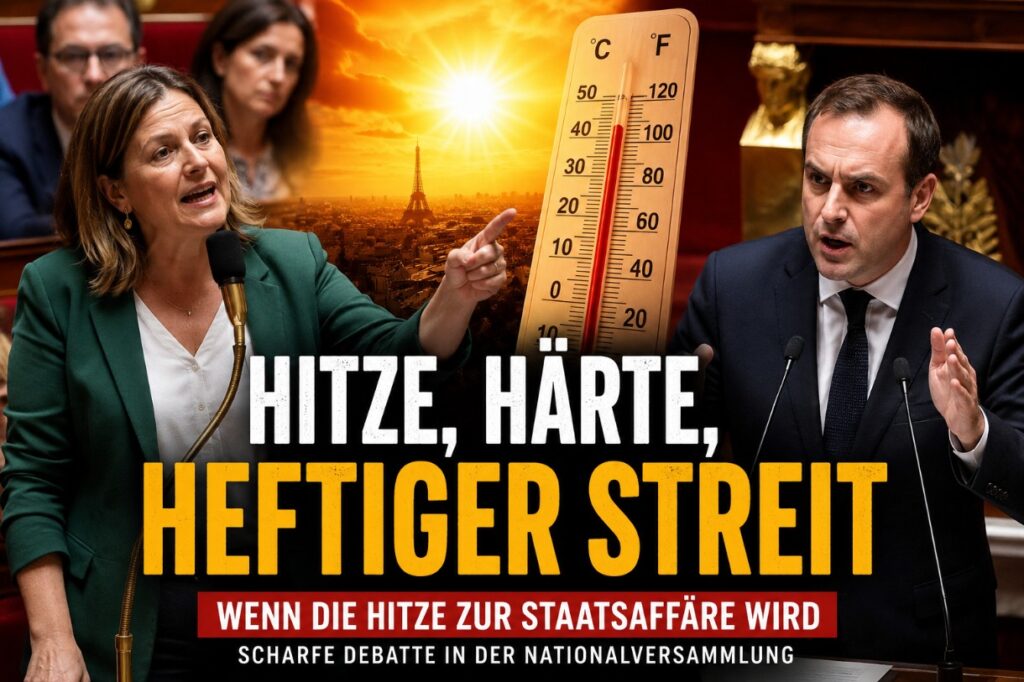
Paris shimmers. The asphalt stores the heat deep into the night, fans run at full speed, and in many apartments even open windows fail to bring the hoped-for relief. The exceptional heatwave has France firmly in its grip. But while temperatures rise outside, tempers in the Palais Bourbon are heating up at least as strongly.
In the National Assembly, during question time directed at the government, a clash developed that went far beyond routine party politics. It was about responsibility, protecting the population, and whether France is adequately prepared for the consequences of climate change.
The debate was triggered by Cyrielle Chatelain, chair of the Greens’ parliamentary group. In clear language she accused the government of having underestimated the impacts of recurring heatwaves for years. Extreme temperatures were no longer an exceptional event, she said, but a reality to which the state and society must permanently adapt. In her view, there is still a lack of a comprehensive strategy that goes beyond short-term emergency measures.
She spoke particularly critically about the situation in schools, care homes and hospitals. Many buildings are hardly equipped for such weather conditions. Older people, those with chronic illnesses and children are among those who suffer most from the extreme temperatures. In her speech she also pointed to a high human toll and cited a figure of 10,000 deaths.
That remark visibly unsettled the incumbent Prime Minister Sébastien Lecornu.
“There is no inaction,” he replied forcefully. Almost immediately he followed with the counter-question: “Where does this tally of 10,000 deaths come from?” The usually rather matter-of-fact head of government spoke unusually energetically and made it clear that he firmly rejects the accusation of lacking action.
He then listed the measures that the government says are already underway. The heat action plans have been activated, prefects and emergency services are working closely together nationwide, and hospitals have received additional support. For particularly burdened clinics, additional air-conditioning units have even been procured to better protect patients and medical staff from the extreme heat.
The exchange lasted only a few minutes — but its political impact is likely to last much longer.
Because the heatwave is already changing much more than people’s everyday lives. It is also changing the political debate. Few other issues currently make as visibly clear how different the ideas are about what answers France should find to climate change.
While the government emphasizes that existing emergency plans are working and state authorities are responding quickly, the opposition demands a fundamental shift. Cities must be more heavily greened, public buildings better insulated, and infrastructure consistently adapted to a hotter climate. It is no longer just about coping with crises, but about preventing them better in the future.
Anyone walking through French cities these days quickly understands why the issue moves people. Shaded spots are rare, parks fill up early in the morning, and drinking water fountains become important meeting points. Many families try to spend the hottest hours of the day indoors. At the same time, firefighters, emergency services and medical staff are working under exceptionally difficult conditions.
Numerous schools have also had to adjust lessons or close temporarily. Hospitals are seeing an increase in heat-related emergencies. Care facilities are paying particular attention to their residents, because for older people every hour of sufficient hydration and cooling counts.
The political discussion therefore acquires a particular sharpness. It is no longer about abstract climate models or long-term scenarios. The consequences are visible right on the doorstep, in classrooms, hospital wards and in the homes of many people.
That Sébastien Lecornu reacted unusually emotionally during the debate did not go unnoticed by political observers. His appearance was widely commented on and interpreted as an expression of the enormous pressure under which the government stands in the face of the exceptional weather situation.
However, the real question goes far beyond the heated exchange in the National Assembly. How can a country be prepared for summers that increasingly bring new temperature records? What investments are necessary so that schools, hospitals and public institutions are fit for the coming decades? And how much time is left before exceptional heatwaves become a normal part of everyday life?
The answers to these questions are likely to occupy France for a long time. The exchange in parliament was therefore much more than a political episode. It made clear that adapting to climate change has long since become one of the country’s central future tasks — and that the right path there is being debated with great passion.
An article by M. Legrand