
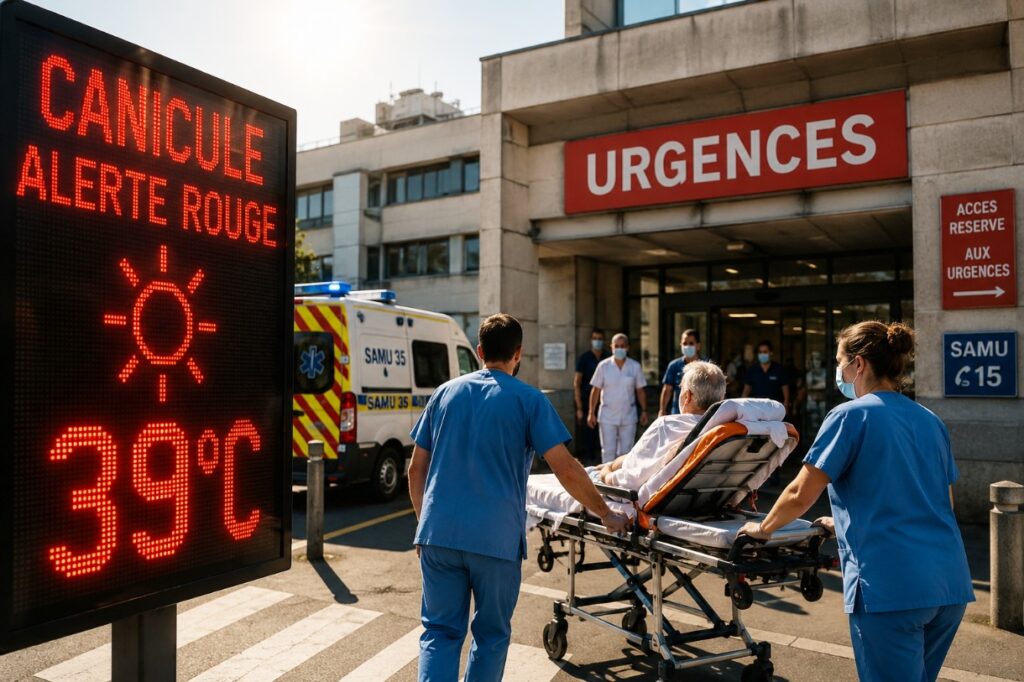
The oppressive heatwave in France ruthlessly exposes how fragile the healthcare system has become. This is particularly evident at the University Hospital of Rennes. There, the emergency department and ambulance services are under massive pressure due to the high temperatures. The number of emergency calls has skyrocketed within a short time, waiting rooms fill up faster than usual, and medical staff are already working at a relentless pace.
Incidents are especially frequent along the Breton coast. Young people who lie in the sun for hours or exercise collapse suddenly. Doctors report circulatory problems, severe dehydration, and classic heat strokes. Many cases can be quickly stabilized — a few infusions, some shade, plenty of water. But the real concern runs deeper.
Because with every additional hot day, the number of elderly patients whose already weakened bodies give out increases. Heart problems worsen, respiratory diseases spiral out of control, and chronic ailments topple like dominoes. Elderly people who live alone or receive little support are particularly at risk in such weather conditions. Doctors quietly speak of a silent crisis. Not a spectacular drama, but rather a slow overflow of an already bursting basin.
And that is exactly the problem.
French hospitals have been operating at full capacity for years. Care staff are lacking, wards occasionally close beds simply because there is no one left to care for patients. In Rennes, many beds were already empty during the heatwave — not for comfort reasons, but due to a staff shortage. At the same time, the summer phase that hospital administrations fear every year is beginning: the holiday season in August. Then millions of people flock to the coasts, while smaller emergency rooms in rural areas sometimes close temporarily. A risky cocktail.
The heat acts like a magnifying glass. It exacerbates problems that have long existed. France still remembers well the 2003 heat summer, when thousands of people died and the country was shocked by an overwhelmed healthcare system. Since then, better warning systems have been developed, care facilities received clear emergency plans, and prevention campaigns reached many citizens. In fact, nursing homes and clinics today respond faster and more coordinated than back then.
But climate change is changing the rules of the game.
Extreme heat used to be considered an exceptional situation. Today it returns almost every summer — sometimes earlier, more intense, and longer. Doctors now regularly experience days when emergency services are constantly on the move and emergency rooms can hardly catch their breath. Some medical professionals openly say: The healthcare system must learn to handle heatwaves as naturally as flu waves in winter. It sounds matter-of-fact. But it is a tremendous challenge.
Because a hospital cannot simply be started up at the push of a button like an air conditioner.
In the end, this heatwave therefore tells more than just a weather story. It shows how closely climate issues and public health are now interconnected. And it makes visible what many healthcare workers have been saying for a long time: A permanently overburdened system immediately falters with any additional crisis. That is exactly what is happening right now in France — and frankly, all of Europe is watching quite closely.
By C. Hatty