Back

Nachrichten.fr · May 16, 2026

Where Women Keep the Farm Running

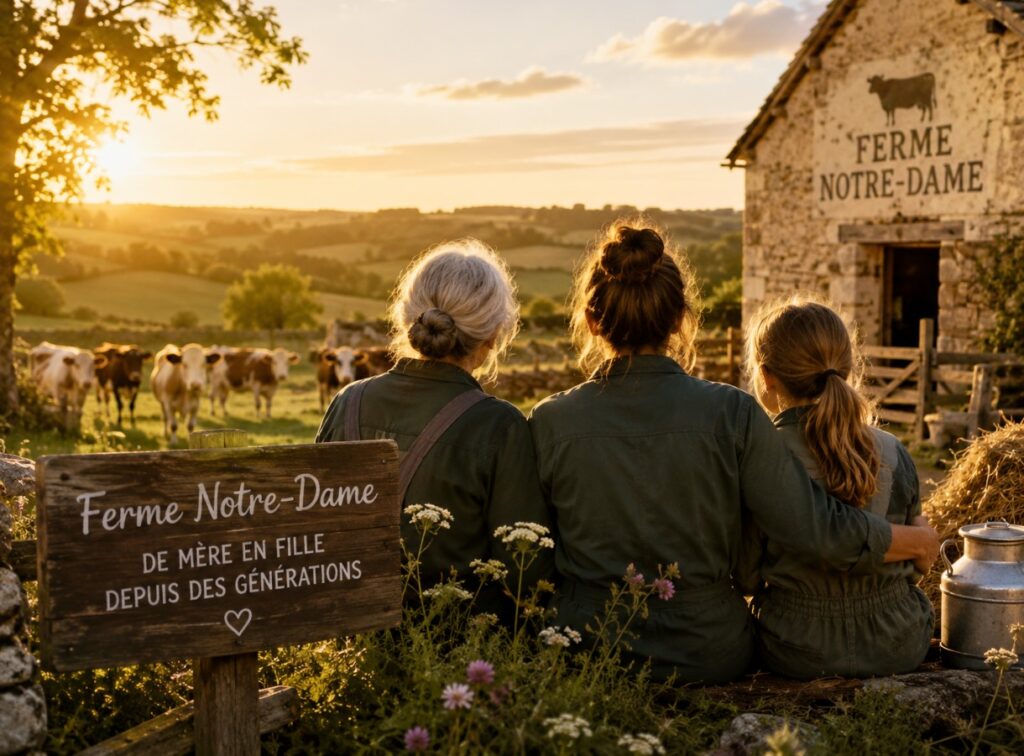
Early in the morning a thin veil of mist still hangs over the hills of the French département Lot. The limestone landscapes of the Quercy seem almost unreal and silent at this hour. Only somewhere behind the small country lanes a tractor is already humming, and from a barn comes the muffled scraping of hooves on concrete. Exactly there, in the middle of the Causses du Quercy Nature Park, lies the Ferme Notre Dame near Belfort du Quercy. A farm like many others – one might think.

But this farm tells a story that has been touching many people in France recently.

Because here agriculture has been passed from women to women for generations.

Mother to daughter.

And again to the next daughter.

While elsewhere farms are closing because no one wants to take over the profession, three women here stand together in the barn every morning. Isabelle Lavergne and her daughters Solenne and Isaure Ferrer Diaz run the operation together. They milk cows, organize sales, receive visitors and take care of the daily work that on a farm never ends.

So not a romantic postcard routine.

But real country life.

With cold winter nights, long days and hands that look like they’ve worked.

Anyone visiting the farm quickly notices that the atmosphere feels different from some highly industrialized agricultural operations. The buildings are modest, the distances short, the animals calm. Instead of vast machinery yards or sterile halls, proximity shapes everyday life here. Proximity to the animals. Proximity to the landscape. And also proximity to the people who visit the farm.

Perhaps that is exactly the secret behind the great attention the Ferme Notre Dame has received in recent months.

France has been discussing the future of its agriculture for years. Small farms are disappearing. Young people move to the cities. Many farmers no longer find successors. Increasingly, buildings that once fed families stand empty.

And suddenly this story appears from the Lot.

Three women.

Several generations.

A farm that keeps going.

It almost sounds like an old family novel.

But the everyday reality is anything but nostalgically idealized.

The alarm clock rings early. Very early. Even before the sun appears over the dry hills of the Quercy, the first work in the barn has already begun. Cows do not wait. Animals know no Sunday, no holiday and no sleeping-in day after a long night.

Solenne Ferrer Diaz has described in interviews and on social networks several times how strongly her life is shaped by the animals’ rhythm. Milking, feeding, bedding, organizing, repairing – the tasks change constantly. Sometimes everything runs smoothly. Sometimes a single sick animal is enough to throw the entire day off schedule.

And yet many young women stay on the farm.

Why, actually?

Who voluntarily chooses today a profession with little free time, physical labor and economic uncertainty?

Maybe precisely those people who see more in it than just a job.

At the Ferme Notre Dame agriculture does not appear to be only a business model. The farm seems rather part of a family identity. Passing on the farm there does not merely mean handing over buildings or land. It is about memories, routines and knowledge that were often never written down.

How can you recognize early enough when a cow is getting sick?

Which hay is better after an especially dry summer?

When does the sky over the Quercy announce a storm?

Such things no one fully learns from books.

They are passed down from generation to generation.

And it is precisely this female line of tradition that is currently fascinating many people in France. Because the image of agriculture is still strongly male to this day. For decades one almost automatically spoke of the “farmer,” even when women on farms often worked just as hard.

Many wives of farmers kept the books, tended the animals, helped in the fields and raised children on the side – without ever being officially visible as farm managers.

The women worked.

The men were considered the bosses.

It was often that simple.

The story of the Ferme Notre Dame suddenly reverses that perception. Here women are visibly at the center. Not as marginal figures. Not as helpers.

But as the bearers of the entire farm.

That triggers something.

Especially in a time when many people are again searching more intensely for authentic stories.

For real biographies.

For places that don’t look polished like advertising brochures.

Visitors therefore don’t come just for the dairy products. Many want to experience what agriculture actually looks like today. The farm offers guided milking times. Children watch the animals fascinated. Adults ask questions about feeding, prices or the daily life of a dairy operation.

Some are amazed at how much work goes into a simple liter of milk.

Others suddenly realize how far removed they themselves have long been from the origin of their food.

In the supermarket milk sits neatly chilled on the shelf.

On a farm it begins with work at five in the morning.

The cows of the Ferme Notre Dame mostly have pasture access. They are fed mainly with hay and grain from the farm’s own production. This rather down-to-earth model fits the farm’s philosophy: regional, manageable and direct.

No one here seems to be aiming for large industrial expansion.

And that makes the farm seem almost charmingly old-fashioned to many people.

Of course visitors sometimes romanticize country life. Someone who only goes to a farm for two hours rarely sees the worries behind it. Small dairy farms in France, in particular, are currently constantly struggling with rising costs, price pressure and bureaucracy.

The list of problems is long.

Feed becomes more expensive.

Energy prices fluctuate.

Drought periods are increasing.

On top of that come ever new regulations.

Some farmers now say half jokingly that they spend almost more time on forms than with their animals.

Farmers in the Lot also feel the effects of climate change clearly. Summers are getting hotter and drier. Meadows suffer from lack of water. That changes the entire planning of a farm.

In the past you could rely more on the seasons.

Today much feels more uncertain.

That is precisely why the story of the three women reads like a counter-image to the general mood of crisis.

It does not show perfect agriculture.

But a resilient one.

And maybe that is what touches people.

On social networks posts about the Ferme Notre Dame collected thousands of reactions. Many users wrote that the family reminded them of their own childhood in the countryside. Others praised the courage of the young generation.

One word appeared particularly often:

Passion.

Because without passion such a daily life is probably hard to sustain.

The farm also lives from direct contact with consumers. More and more small operations in France rely on short distribution channels. They sell products directly on site or at regional markets. This keeps more value added on the farm itself.

At the same time trust is created.

When you know the people behind a product, you often view food differently.

Suddenly it’s not only about a price.

But also about faces.

About stories.

About relationships.

One visitor said after a farm tour, in essence, that he had for the first time understood how emotional agriculture actually is. Cows are not production machines, but animals with their own character.

And indeed many farmers speak of their animals almost like family members.

One cow remains calm.

Another is nervous.

A third is constantly mischievous.

Well — apparently every farm has its little divas.

The emotional bond also explains why many farmers do not want to give up their profession despite economic difficulties. Farming is rarely only a source of income. It reaches deep into personal identity.

Whoever takes over a farm often also takes on the history of their family.

That applies especially at the Ferme Notre Dame.

There each generation seems to quietly nod to the women before them.

We carry on.

This thought has something almost poetic about it.

Perhaps that is why some recent media reports even spoke of an exceptional story in rural France.

Because indeed thousands of smaller farms disappear each year. Especially livestock farming is considered off-putting to many young people. The working hours are hard, incomes often uncertain. Added to that is societal pressure around environmental issues and animal husbandry.

Many farmers feel misunderstood.

Between political debates, consumer demands and economic reality there often emerges a feeling of constant justification.

Precisely for that reason the story of the women from Belfort du Quercy generates so much sympathy. It seems honest. Unaffected. Without great staging.

Perhaps people today long more for such narratives because much in modern everyday life has become interchangeable.

A small farm with family tradition suddenly appears like an antidote to the fast world.

Almost a little out of time.

And yet highly topical.

Because the questions behind it concern all of France.

How can agriculture be maintained in rural regions?

How do farms find successors?

How can appreciation for food be restored?

The Ferme Notre Dame does not provide big political answers to these questions.

But it shows a possible direction.

Smaller farms today often try to remain visible through personality. It is not quantity that counts, but trust and closeness. Visitors want to understand where their food comes from. That is exactly where an opportunity arises for many family farms.

Of course sympathy alone is not enough to survive economically. Farming remains a tough market. Nevertheless, many new ideas around direct marketing, agritourism and regional products are currently emerging in France.

The women from the Lot are moving right in the middle of this development.

Without grand pathos.

Simply pragmatic.

The farm opens up to visitors, shows everyday life and creates encounters. That seems almost simple – yet it is precisely this simplicity that touches many people.

Especially city dwellers often experience a small culture shock on such farms. There the speed of a smartphone counts for little, but rather the rhythm of the animals and the seasons.

A cow cares very little about online trends.

It wants to be milked on time.

Period.

And perhaps in that lies an unexpected form of calm.

When you look out over the landscape of the Quercy, you quickly understand why many families remain deeply rooted there. The region has something rugged and at the same time peaceful. Dry stone walls run through the hills. Small villages cling to the roads. In summer the air smells of dust, grass and warm stone.

Not spectacular.

But striking.

The Ferme Notre Dame fits perfectly into this environment. Not a glossy operation, but a farm that has remained part of its landscape.

And perhaps that is why it seems credible.

Public attention has likely changed the family’s everyday life by now. Visitors sometimes recognize the women from TV programs or social networks. Media want to conduct interviews. Comments accumulate online.

Yet despite this new recognition the core of the farm seems to have remained the same.

The work still waits every morning.

Cows, after all, know no media break.

That is precisely what makes the story sympathetic. Behind all the reports there is no marketing concept of a large corporation, but a family living its everyday life.

With successes.

With worries.

With tiredness.

And with a remarkable persistence.

The female succession of the farm develops an almost symbolic power. France has seen a more visible role of women in agriculture in recent years. More and more women farm managers appear publicly, start projects or take on responsibility.

But the old perception disappears only slowly.

Some people are still surprised when women drive tractors or run livestock farms.

As if agriculture were automatically a man’s domain.

The women of the Ferme Notre Dame show quite calmly how outdated that image now is.

They do not constantly talk about feminism.

They simply work.

Perhaps that is exactly the most powerful effect.

Because sometimes stories change people more than political debates.

A farm in the Lot.

Three women.

Suddenly that’s all it takes.

While France discusses agricultural crises, falling incomes and the future of rural regions, a quiet narrative about succession, solidarity and down-to-earthness is emerging there.

No hero staging.

No cheesy farm-romance.

But a family that keeps going.

Day by day.

And that is exactly why the Ferme Notre Dame stays in many people’s minds.

Because it reminds us that agriculture in the end always remains human.

Not abstract.

Not theoretical.

But connected to faces, voices and stories.

Perhaps that is why so many people are currently looking to Belfort du Quercy with curiosity.

Because this small farm in southern France embodies something that has become rare:

Continuity.

In a world that constantly changes.

An article by M. Legrand